Meet Martha, a Friend of Jesus

Luke 10:38-41, NCV

“While Jesus and his followers were traveling, Jesus went into a town. A woman named Martha let Jesus stay at her house. 39 Martha had a sister named Mary, who was sitting at Jesus’ feet and listening to him teach. 40 But Martha was busy with all the work to be done. She went in and said, “Lord, don’t you care that my sister has left me alone to do all the work? Tell her to help me.”

41 “But the Lord answered her, “Martha, Martha, you are worried and upset about many things. 

42 Only one thing is important. Mary has chosen the better thing, and it will never be taken away from her.”

My name is Martha and I’m a friend of Jesus. My home was one of His favorite places to stay–a refuge for Him whose life was so busy. I joyfully opened my house for Him and His disciples. When Jesus came I went all out, I wanted the best for them and that meant there were always things to do. Is that really a bad thing?

The kitchen was verging on bedlam–lamb, cucumbers, figs, and so on. Roasting and slicing, I had bread in the oven. All of this was requiring constant attention, and I remember not being able to keep up.

I wanted things to be perfect for Jesus.

I took occasional peeks at He who was teaching in my living room. I just brought in some bowls of figs and raisins as an appetizer and found my sister Mary sitting with the men listening to Jesus and asking questions. It was that which started to get a little ticked off.

I was getting irritated.

There was so much to do and I realized I had to have her help. And the more I thought of Mary the more frustrated I got. I suspect she didn’t understand the work that need to be done. I suppose her priorities were messed up–she simply didn’t understand her role as a hostess, and to sit with the men like she was doing was wrong.

Mary didn’t understand her place.

I admit I was having issues with my sister. I had brought out another bowl of figs and that’s when I gently interrupted the Lord’s teaching. I wanted Him to tell Mary that her place was with me in the kitchen. He could correct her and I knew she would listen. “Tell her to help me.”

Instead, it was Jesus who corrected me. I still remember Jesus’ words. I wasn’t expecting this.

“Martha, Martha, you are worried and upset about many things.”

Was I really that transparent? He understood, but rather than encouraging me I had become another lesson to everyone present. I realize now that the real issue was with my attitude, and not the work. Yes, I was bothered and upset and I know that it’s those things that were the problem.

Only one thing is important. Mary has chosen the better thing, and it will never be taken away from her.”

I suddenly knew that He was right. Jesus was in my home, and all I did was get angry. I thought my work would please Him and after all, wasn’t that important? Didn’t He “deserve” my best efforts?

My younger sister Mary was being praised. She was my example and now I was being gently rebuked. I realized that all I was doing, all my work, was not what Jesus wanted from me. The problem was my own heart—-it wasn’t Mary, it was me!

I had taken my eyes off of Jesus and was immersed in my service to Him.

I had become critical and resentful of Mary, and I had forgotten that my place was at Jesus’ feet, listening and learning. That’s what Jesus wanted from me, and somehow I had forgotten that. The work could wait, my real place was with Jesus.

Martha’s frustration is typical of those who diligently serve with good intent, but forget to also sit at Jesus’ feet. “The Martha spirit says, if the work is done, is not that all? The Mary spirit asks whether Jesus is well pleased or not? All must be done in his name and by his Spirit, or nothing is done.”
C.H. Spurgeon

Discipleship Can Hurt

Luke 9:57-62, NIV

57 As they were walking along the road, a man said to him, “I will follow you wherever you go.”

58 Jesus replied, “Foxes have dens and birds have nests, but the Son of Man has no place to lay his head.”

59 He said to another man, “Follow me.”

But he replied, “Lord, first let me go and bury my father.”

60 Jesus said to him, “Let the dead bury their own dead, but you go and proclaim the kingdom of God.”

61 Still another said, “I will follow you, Lord; but first let me go back and say goodbye to my family.”

62 Jesus replied, “No one who puts a hand to the plow and looks back is fit for service in the kingdom of God.”

There’s to be no whitewashing the way of discipleship–there’s no glamour, no special recognition–no acclaim in it. I guess this is the “real” way of being His follower. The path Jesus has for me demands I give Him my whole heart. Heart enough to turn it all to Him. Heart enough to give Him total commitment.

Jesus seems to make it hard–we can see this in His responses to each prospective disciple. His statements to each possible follower seem harsh, difficult, and a bit “unreasonable,” but He doesn’t receive these men unless they do what He says.

Discipleship demands that we give up what we hold dearest.

What happened to these three “would-be” followers? Did they return home dejected and frustrated? To follow in Jesus’ footprints means we give up our personal agendas, and turn our backs on what is closest and dearest. We must renounce everything, and give Him preeminence over all.

These are hard verses with profound implications. But this passage is given to us for a reason. We dare not minimize what it means to be a disciple. We must grasp the plow with both hands, and we can’t look back.

“Christianity without discipleship is always Christianity without Christ. Unless he obeys, a man cannot believe.”

    Dietrich Bonhoeffer

Meet the Demon-Possessed Boy

Luke 9:37-43

“On the next day, when they had come down from the mountain, a great crowd met him. 38 And behold, a man from the crowd cried out, “Teacher, I beg you to look at my son, for he is my only child. 39 And behold, a spirit seizes him, and he suddenly cries out. It convulses him so that he foams at the mouth, and shatters him, and will hardly leave him. 40 And I begged your disciples to cast it out, but they could not.” 41 Jesus answered, “O faithless and twisted generation, how long am I to be with you and bear with you? Bring your son here.” 42 While he was coming, the demon threw him to the ground and convulsed him. But Jesus rebuked the unclean spirit and healed the boy, and gave him back to his father. 43 And all were astonished at the majesty of God.”

All of this takes place immediately after Jesus’ transfiguration. He has shown Himself to be God, wrapped tightly into manhood–He’s fully and completely the Word made flesh. He is the Creator, and He is holding the universe together. Who really can fathom this?

Full of power, but also completely covered with incredible compassion. He meets this desperate man, a man who is carrying incredible weight, a burden that had taken over his life. Jesus steps into a theological circus, after all, the Scribes had shown up, and the disciples were disputing with them. The terrible need of the demonized boy had been forgotten.

The disciples had tried to free him, they really had.

But between the gathering crowd and the arguing Scribes, they were overwhelmed–completely out of their element. Defeated, they didn’t know what to do. (Isn’t this a description of much of today’s church?)

The father of the demonized boy was incredibly desperate. He watched the bizarre scene unfold yet knew he had no other answers. He despaired but continued to wait. What else could he do, there were no other options. He really tried to wait for Jesus Himself. He needed Him.

Sometimes we as the Church stress theological niceties, and look beyond the awful needs around us. We rather debate than serve. We prefer to argue rather than meet the incredible pain around us. How sad is this? We constantly meet terrible pain, and we choose to reside in some strange theological bubble of our own making.

When Jesus comes down from glory on the mountain, He immediately faces off with a desperate man and a demonized son. This father is terribly overwhelmed–the disciples had made a try (or two) and yet couldn’t free the boy. The demons had ignored their efforts and laughed at attempts to free him. These demons decided to stay inside this boy. The disciples can do nothing about it.

But when Jesus shows up, all hell breaks loose.

There is amazing power here. Jesus, already shown to be God on the mountain top, now declares His authority over the ugliness of the darkness. He’s been unleashed and absolutely demolishes the works of Satan. He dismantles the evil and decisively frees the boy.

The text tells us, “And all were astonished at the majesty of God.” We can link this power to what we’ve seen on the mountain top–His Words are powerful enough to hold the world in place! He is the Almighty One that has chosen to walk shoulder-to-shoulder with us. He pushes against the darkness and sets us free.

“But have we Holy Spirit power – power that restricts the devil’s power, pulls down strongholds and obtains promises? Daring delinquents will be damned if they are not delivered from the devil’s dominion. What has hell to fear other than a God-anointed, prayer-powered church?”

   Leonard Ravenhill

Meet the Widow, and Her Simple Pennies

Mark 12:41-44

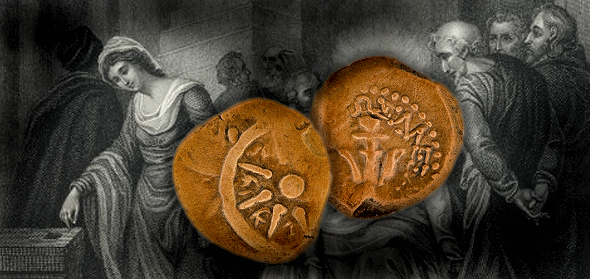
41-44 Sitting across from the offering box, he was observing how the crowd tossed money in for the collection. Many of the rich were making large contributions. One poor widow came up and put in two small coins—a measly two cents. Jesus called his disciples over and said, “The truth is that this poor widow gave more to the collection than all the others put together. All the others gave what they’ll never miss; she gave extravagantly what she couldn’t afford—she gave her all.”

It wasn’t much but it’s all I had. Some would laugh, most would scorn–but truthfully, I really wasn’t giving my money, I was giving my heart. That’s all, just my little tiny heart.

When my husband died, I was left with very little. What I did have I hid in a hole in the wall, but I was concerned, money was going out and nothing was coming in. Often I sat on my stool and stared at that hole, and often I was pretty frightened. There is nothing to live on. What was I going to do?

Please understand. No one was going to help me.

I got up one morning to pull out the leather sack, all that was there were two pennies. That’s it. Two very small pennies, and that’s all I had to live on! I knew that this day would come, but it seemed to come so soon. I shook with fear at what life was going to bring next.

————————–

Jesus sat watching the crowd in the Temple with the twelve. Occasionally there was a procession: trumpets blowing and bright banners waving. Another rich man announced to everyone that he was coming to contribute to the Temple. There were six stone receptacles placed in strategic spots, where people could tithe as the Law required of every Jew.

Jesus was watching all of this.

Suddenly an old woman came to give, and there were no trumpets, no fanfare. She simply came to give what she had–two very small copper pennies. Just two pennies. Most would laugh I suppose. After all, the rich were dropping in thousands of silver.

It was funny, but Jesus turned to His disciples. They sat and listened carefully to what He had to say:

“Truly, I say to you, this poor widow has put in more than all those who are contributing to the offering box.”

They gasped as they struggled to understand the Teacher. It seemed idiotic, but Jesus often said many outrageous things. You could see their minds working to grip this. It made absolutely zero sense.

“They all contributed out of their abundance, but she out of her poverty has put in everything she had, all she had to live on.”

The twelve were dumbfounded.

———————-

When I gave, I gave my heart. I had nothing, but you know, a strange peace came over me. I rejoiced to do this, to give to God and His work. Yes, I now had nothing–nothing but the grace and care of God. Maybe I was a fool. Maybe I was stark raving mad. But I knew what I wanted to do. When I threw in my two pennies, I threw myself into the heart and care of God.

What was going to happen next? I really don’t know, but we will find out, won’t we?

“Don’t be afraid, you tiny flock! Your Father plans to give you the kingdom. Sell your possessions and give the money away. Get yourselves purses that never grow old, inexhaustible treasure in Heaven, where no thief can ever reach it, or moth ruin it. For wherever your treasure is, you may be certain that your heart will be there too!”

Luke 12:33, Phillips

Art: Coin Week; verses used are from The Message, a translation of Eugene Peterson

Meet the Centurion and Discover Real Faith

Matthew 8:5-13

 When Jesus had entered Capernaum, a centurion came to him, asking for help. “Lord,” he said, “my servant lies at home paralyzed, suffering terribly.”

Jesus said to him, “Shall I come and heal him?”

The centurion replied, “Lord, I do not deserve to have you come under my roof. But just say the word, and my servant will be healed. For I myself am a man under authority, with soldiers under me. I tell this one, ‘Go,’ and he goes; and that one, ‘Come,’ and he comes. I say to my servant, ‘Do this,’ and he does it.”

10 When Jesus heard this, he was amazed and said to those following him, “Truly I tell you, I have not found anyone in Israel with such great faith. 11 I say to you that many will come from the east and the west, and will take their places at the feast with Abraham, Isaac and Jacob in the kingdom of heaven. 12 But the subjects of the kingdom will be thrown outside, into the darkness, where there will be weeping and gnashing of teeth.”

13 Then Jesus said to the centurion, “Go! Let it be done just as you believed it would.” And his servant was healed at that moment.

Obedience had been ingrained in me. I understood authority and submission to my superior officers. It’s called “the chain of command” and it’s the reason why armies function the way they do. I ultimately acceded my will to my superior, who’s under authority himself. I also have soldiers who I command. I led over 100 men as the occupying force in Palestine.

We were hated and despised.

My servant was sick, and I knew that he was suffering greatly, but I had run out of options. My servant was the only family I was allowed to have. Since I served as a centurion I was not allowed to have a wife for the duration of my service. Over the years I’ve kept good and trustworthy servants with me–these men were very dear to me. They became my family.

I certainly was aware that both my men and I lived in constant danger from radical Jews.

I had exhausted all my efforts to bring some relief and healing to him–and it seemed to be getting worse, not better. My “contacts” told me of an itinerant teacher who had a reputation as a healer. It seems Jesus had a large following and I realized that He could be my last option.

So I went to Him for help and Jesus responded. But He wanted to go with me to my home. His willingness to come encouraged me, but I simply couldn’t allow that. Jesus’ visit would’ve made Him ceremonially unclean–I was a Gentile, a “dog.”

My home was off-limits.

But I did understand something. I was under authority as an officer in the Roman army, and my men also took orders. Obedience meant survival in a hostile environment like Judea. Our entire unit was drilled constantly and we all understood the need for a “chain of command.” Each of us obeyed our superiors. We had to.

With all this in mind, I asked Jesus to heal my servant with just a word.

He marveled at this. He said that my adherence to protocol was evidence of real faith. Those who were with Jesus were told something earth-shaking. My trust meant something, He made me an equal with the Israel patriarchs. My faith was to be emulated by the Jews.

He then told His followers that my confident trust was respected and acknowledged as evidence of God’s favor.

Simply, Jesus spoke a word and when I returned home my servant would be healed. I returned home to find him healthy.

“Christ will always accept the faith that puts its trust in Him.”

    Andrew Murray

Please visit my new site, alaskabibleteacher.com. If you liked this teaching, I really think you like this one too.

Little Christs

Luke 9:1-6, Amplified

Now Jesus called together the twelve [disciples] and gave them [the right to exercise] power and authority over all the demons and to heal diseases. Then He sent them out [on a brief journey] to preach the kingdom of God and to perform healing. 

And He said to them, “Take nothing for your journey [that might encumber you]—neither a walking stick, nor bag, nor bread, nor money; and do not even have two [b]tunics apiece. Whatever house you enter, stay there until you leave that city [to go to another]. And as for all those who do not welcome you, when you leave that city, shake the dust off your feet [breaking all ties with them] as a testimony against them [that they rejected My message].” 

So they began going from village to village, preaching the gospel and healing the sick everywhere.

Jesus called the twelve of us together that day for a reason–He wanted us to start doing His work, which, I admit wasn’t really in my thinking. But this was His plan, and He knew exactly what He was doing. I didn’t feel remotely competent, and the thought of doing what Jesus did seemed a bit sacrilegious. I was very intimidated.

But now I can see that was what He intended all along, to push us into the supernatural–preaching, healing, and exorcising demons. He wanted us to touch people, to meet the needs of the desperate, and by doing so, extend the kingdom of God.

We were all skeptical, obviously. We weren’t Jesus, not by a long shot, and we had no right or ability to do miracles. On our own, I we were still fishermen and tax collectors. And honestly, what Jesus was asking (or commanding?) was for us to leave what we felt was comfortable and to step into His sandals. He wanted us to be just like Him.

He gave us His authority and power–it was His to give.

I suppose that this was the key to it all. We had witnessed fantastic miracles, stunning things that pretty much undid us. Jesus repeatedly defied the laws of nature—with just a word. And we’re His disciples, so I suppose that meant we needed to step out and touch people just like He taught. I guess that was Jesus’ plan for us all along. We just thought it wouldn’t happened this quick.

So the power and authority was given and we became “little Christs.”

Two by two we went in different directions to discover for ourselves what would happen. The needs we encountered were substantial. The world was a needy place that made its home in the pain and darkness of the demonized and the desperate. It seemed overwhelming. I think we all felt weak and very inadequate.

It’s funny, but we suddenly saw all these people through His eyes–it’s like we never had seen them before. We were now cloaked in Jesus’ very own power. When we laid hands on people astonishing miracles began to happen. All at once there were needs all around us. And the people kept coming.

I began to understand what it really meant to love people. We had left the relative safety of learners and had now became doers. I suppose we realized that there was an incredible difference between the two. We were all astonished by what we saw, at that moment we had few doubts about what was happening inside of us.

It changed us like nothing else could!

Being made into “little Christs” made perfect sense. We saw fantastic miracles and dramatic victories over dark demons. The things we had seen Jesus do were now the things we were doing! Suddenly everything came together and we understood many of the words that He had tried to drill into our thick skulls.

From village to village we went–we stayed with whoever wanted us. The needs we saw were staggering, from sunrise to sunset people came. Wherever we turned there seemed to be somebody else, but Jesus’ own authority was always present, it never diminished or weakened. It was like a bubbling spring that never once ran dry.

I suppose what happened inside me was just as much a miracle as we had seen Him do for others. I was astonished–up to now I never realized how exciting it was to follow the Lord Jesus. What a joy to see the face of a man or woman who was set free. It was such a thrill to touch a little boy’s dead eyes and suddenly realize that he could see!

So this is what it honestly means to be His disciple!

“Truly I tell you, the one who believes in me will also do the works that I do. And he will do even greater works than these, because I am going to the Father.”

John 14:12

The Sword Meets the Ear of Malchus

Luke 22:49-51, CSB

“When those around Him saw what was going to happen, they asked, “Lord, should we strike with the sword?” 50 Then one of them struck the high priest’s servant and cut off his right ear.

51 But Jesus responded, “No more of this!” And touching his ear, he healed him.

How should we proceed with this? Perhaps we should start with the garden of Gethsemane. The setting explains a lot. Jesus is praying alone and He asks His Father for the strength to make it to His cross. It’s said that at that He sweated out what was like drops of blood.

The usual way of praying for a Jewish man was standing, but here we read that Jesus was on His knees. We also read that an angel showed up–it says that this angel came with strengthening power. The Greek word for “strengthen” can mean to invigorate. I believe Jesus’ prayer was answered (but not the way He wanted).

Jesus now had the strength to stand up and face the terror of the cross.

Judas led the mob that came to arrest Jesus. There was the kiss of betrayal and I suppose that the torchlight wasn’t really enough to identify Jesus outright. Judas’ kiss goes into the history books as the ultimate act of a traitor. It’s probably the most wicked kiss ever given to another.

What happens next seems to come out of an R–rated movie script. Peter takes up a sword and slashes and connects with a guy named Malchus who was the servant of the high priest. An ear is chopped off and Peter has a bloody sword, but not so fast. Jesus insisted that this is not the way of a true disciple.

Some would suggest that having good swordsmanship is a vital characteristic of a follower of Jesus.

But I don’t think so.

Jesus stops the whole scene to pick up Malchus’ ear and reattach it. Peter is definitely rebuked (notice the exclamation mark in verse 51)! Being a believer means following Jesus to the garden, and then the cross. Often we look at anything that avoids these places. When we’re truly following Him we are commanded to take up our own cross daily.

“When the Church takes sword in hand, it usually shows that it does not know how to wield it, and as often as not has struck the wrong man.”

Maclaren

Malchus plays such a minor role, and yet the ear amputation speaks volumes. We discover that the implications clarify the Lord’s desire for His followers–something that makes it clear that, “His ways are not our ways.”

Even in the garden, facing arrest and torture, Jesus is still reaching out to those around Him. Malchus is Jesus’ last ‘physical’ healing of another–He is kind and merciful, and He shows us how to love our enemies.

Today is Maundy Thursday. Tomorrow the pain of the cross. But He’s in the garden now, and recognizes exactly what is going down. “But this is your hour, and the power of darkness.”

“You have heard that it was said, ‘You shall love your neighbor and hate your enemy.’ 44 But I say to you, Love your enemies and pray for those who persecute you,”

Matthew 5:43-44

Meet the Master of Ceremonies in Cana

John 2:9-10

When the master of ceremonies tasted the water that was now wine, not knowing where it had come from (though, of course, the servants did), he called the bridegroom over.

10 “This is wonderful stuff!” he said. “You’re different from most. Usually, a host uses the best wine first, and afterwards, when everyone is full and doesn’t care, then he brings out the less expensive brands. But you have kept the best for the last!”

Full account: John 2:1-10

I really don’t believe in miracles. But something happened when I was overseeing a wedding in Cana that I can’t explain. I’ve thought a lot about it and as I uncovered some of the details–well, part of me believes, and part of me can’t.

My duty was to oversee the details that are part of every wedding. That includes having a sufficient source of wine for the party. If I made a mistake or miscalculated the thirst of the guests, it’s the absolute worst thing I could do. Not too much wine (as it could be expensive) or not too little either. If I blew it, it would go down as a shameful thing.

Essentially I freed up the bride and the groom so they could enjoy their day–I handled all of the logistical stuff. It was my ministry you could say, I had a knack for managing these events, it was how I made my living. (It’s all about having a good reputation, and I suppose the shekels were also a part of my thinking too.)

This particular wedding in Cana sort of got out-of-hand.

Too many guests too soon, and man were they thirsty. I brought in the wine, and it wasn’t enough–I was blowing it, and honestly, I really didn’t know how I was going to extricate myself and avoid this incredible goof. Word was spreading fast; we were running out. (People were starting to panic!)

My employees, my servants, gathered around to help me think. They basically gave me the news, and they expected me to do what was out of my power to do. I rarely had encountered a predicament like this. Poor planning on my part and now the groom would take the rap.

I was surprised when the servant came with a cup for me to sample!

Tasting that wine I realized then and there that this was not the usual plonk–as a matter of fact, it was the best that could be found (and I know all about wine, believe me). When I found the groom and told him…”Most serve the best at first, but you rascal, you saved the very best for last!”

I was dumbfounded when I investigated its source. It was water, coming from six purification jars (each one could hold up to 30 gallons). Each one was filled to the brim, and each one became excellent wine. Some have told me that Jesus didn’t add anything–but He transformed it. Now dear reader, perhaps I understood the incredible power of Jesus.

I’m not really a believer quite yet, but maybe?

I suppose that this miracle describes having a life that’s being transformed. As we grow we start to realize that He’s taking us higher up and deeper in. Look for your next step, there’s always much more in “becoming.”

And we all, who with unveiled faces contemplate the Lord’s glory, are being transformed into his image with ever-increasing glory, which comes from the Lord, who is the Spirit.

2 Corinthians 3:18, NIV

Art by Paolo Caliari, (1528-88). Scripture is from the Living Bible, by Tyndale House.

Meet the Older Brother

Luke 15:25-32

25-27 “All this time his older son was out in the field. When the day’s work was done he came in. As he approached the house, he heard the music and dancing. Calling over one of the houseboys, he asked what was going on. He told him, ‘Your brother came home. Your father has ordered a feast—barbecued beef!—because he has him home safe and sound.’

28-30 “The older brother stomped off in an angry sulk and refused to join in. His father came out and tried to talk to him, but he wouldn’t listen. The son said, ‘Look how many years I’ve stayed here serving you, never giving you one moment of grief, but have you ever thrown a party for me and my friends? Then this son of yours who has thrown away your money on whores shows up and you go all out with a feast!’

31-32 “His father said, ‘Son, you don’t understand. You’re with me all the time, and everything that is mine is yours—but this is a wonderful time, and we had to celebrate. This brother of yours was dead, and he’s alive! He was lost, and he’s found!’”

I hated him. I know I shouldn’t but I did. He betrayed all of us by his nonsense. It all started when he demanded that our father immediately divide up our inheritance. Strange I know. It was a shock, like a punch in the stomach. No one knew what to say, it was so bizarre. I have no idea where this idea came from.

He insisted that we divide things up right this instant. He didn’t have the decency to wait for our father’s funeral. It was such a shameful thing that I couldn’t begin to tell you how mortified I was. No one ever heard of anything happening like this before. Even now, after these many years, I can hardly talk about it.

My father simply did what was asked, there was no argument, no resistance.

The property was appraised, and the money was divided up according to custom. We sat at the kitchen table, and the ass watched to make sure that he received every penny that was coming to him. His hungry greed was beyond belief. He oozed arrogance–it was then I really began to hate him.

Never ever had I been so angry and ashamed.

My younger brother never even batted an eye and my father simply did what was asked. My brother didn’t even have the decency to say “thank you.” I desperately wanted to leave, and I couldn’t. I had to be there, and I felt like I was going to throw up.

Enough of that. Let’s move on.

That ass, my younger brother packed up and left. Occasionally I heard of his escapades. There were awful reports of his drunkenness and whoring. He was spending our father’s money as if it would never going to run out. Even talking about it now makes me angry.

The last I had heard was he was now feeding pigs. He had spent every last dime and now it seems he was getting what he deserved. I didn’t shed a tear, I felt no pity. Good, he was getting what he should of gotten all along. I only wished that things would get even worse.

Coming in from the fields I heard a raucous party coming from the house.

I asked one of the servants what was going on. When they told me I was even more shocked. Our father had arranged a celebration, all because my brother had returned. The fatted calf had been killed, the one that was saved for parties, and I heard shouts of joy and dancing. They were celebrating, and that made no sense to me at all.

I had served the estate faithfully, I had sweated to make things work, and I never got a party like this.

My father came out to find me, I had hid out in a shed–I didn’t want to be a part of this awful charade. When he found me he said that the party had to happen. It seems the scoundrel had the audacity to return–the money was spent, and apparently, he came home in rags–it served him right. He got what he deserved.

He told me about the necessity of this celebration.

My mind reeled. Could things get even crazier? Never had I heard of anything so bizarre. It was beyond belief. My father wanted me to come in and join them; I’d rather die. You have no idea.

He kept telling me that this had to happen–apparently he was given a new robe, and worst of all he was given the family ring, the ring that declared that he was now a full-fledged son, someone who could have all of the privilege and authority of a son. I had never heard of such foolishness.

My father said this was necessary, that my brother who I hoped was dead, was now alive.

How bad could things get? Perhaps my father had lost his mind.

“Just so, I tell you, there will be more joy in heaven over one sinner who repents than over ninety-nine righteous persons who need no repentance.”

Luke 15:7

Painting: “The Return of the Prodigal Son by Rembrandt, c. 1667, oil on canvas. This picture shown is a small part. Scripture is The Message, a translation by Eugene Peterson.

Meet Martha

Luke 10:38-42

38 While they were traveling, he entered a village, and a woman named Martha welcomed him into her home. 39 She had a sister named Mary, who also sat at the Lord’s feet and was listening to what he said.40 But Martha was distracted by her many tasks, and she came up and asked, “Lord, don’t you care that my sister has left me to serve alone? So tell her to give me a hand.”

41 The Lord answered her, “Martha, Martha, you are worried and upset about many things, 42 but one thing is necessary. Mary has made the right choice, and it will not be taken away from her.”

Mary wasn’t lazy–I knew that. I saw her sitting at Jesus’ feet, listening to his every word. Perhaps I was jealous, I don’t know. And maybe I knew that I belonged there, to absorb his teaching and those wonderful parables. Looking back at it all, I should have been there too. It was a missed opportunity.

But there was so very much to do.

Jesus was in my home and all the disciples as well. I needed my younger sister’s help. There was cleaning to do. Bread must be baked, olives and figs needed to be washed, cucumbers and melons sliced up. The lamb must be cooked. There wasn’t enough time for me to do this work.

Mary did nothing. She needed to help me, and that was our priority. After all, teaching was for the men, that’s how it was supposed to work. My sister was definitely not pulling her weight. We needed to serve all of these men–they were counting on us.

We should be serving, not sitting.

For a while, I bit my tongue. But I was getting more and more frustrated with her. Couldn’t she see? Why did I have to do all the work? Finally, it had to boil over. I went to Jesus to intervene in Mary’s foolishness. Surely He would do something. He would surely understand my predicament.

“Sir, doesn’t it seem unfair to you that my sister just sits here while I do all the work? Tell her to come and help me.”

I’ll never forget what He said to me. He was kind and loving, the rebuke didn’t originate with Him. It came from inside me. At that moment I knew that my priorities were very wrong–

“Martha, dear friend, you are so upset over all these details! There is really only one thing worth being concerned about. Mary has discovered it—and I won’t take it away from her.”

There are those times when everything becomes crystal clear. Mary was right where she was supposed to be. Jesus knew my anxiety. He completely understood my question, and I knew He was totally aware of me. His word of gentle correction nailed me.

Truly Mary had discovered God’s will, and I had not.

In all my labor I had forgotten what was truly important. Jesus’ words saved me from me. I wasn’t called to work hard; I was called to just sit, next to my sister, listening to the words of my master.