The Catching of the Fish

Luke 5:1-11, ESV

“On one occasion, while the crowd was pressing in on him to hear the word of God, he was standing by the lake of Gennesaret, and he saw two boats by the lake, but the fishermen had gone out of them and were washing their nets. Getting into one of the boats, which was Simon’s, he asked him to put out a little from the land. And he sat down and taught the people from the boat. And when he had finished speaking, he said to Simon, “Put out into the deep and let down your nets for a catch.” And Simon answered, “Master, we toiled all night and took nothing! But at your word I will let down the nets.” And when they had done this, they enclosed a large number of fish, and their nets were breaking. They signaled to their partners in the other boat to come and help them. And they came and filled both the boats, so that they began to sink.” 

“But when Simon Peter saw it, he fell down at Jesus’ knees, saying, “Depart from me, for I am a sinful man, O Lord.” For he and all who were with him were astonished at the catch of fish that they had taken, 10 and so also were James and John, sons of Zebedee, who were partners with Simon. And Jesus said to Simon, “Do not be afraid; from now on you will be catching men.” 11 And when they had brought their boats to land, they left everything and followed him.”

Seriously now. You never try to catch fish during the day. The fish head to the bottom to escape the summer’s heat. At night the fishermen would use a lantern to bring the fish to the surface–that’s just the way it worked. The text makes it clear that Peter’s crew had worked all night. They were incredibly tired, and they didn’t need a simple carpenter to speak to hardcore fishermen.

Jesus had been teaching and Peter’s boat was His pulpit. Jesus had been sharing things that were profound, and Peter had been listening. Perhaps all that he heard resonated deep inside. Jesus’ teaching went far beyond what Peter heard in the synagogue. He knew he was in the presence of the Messiah. For once, he was hearing God’s voice talk to his heart.

Much began to happen at this point in the story.

Jesus requested that they took their nets and go fishing again. This time in broad daylight, and that was something that wasn’t done. It seemed absolutely foolish, and yet this man Jesus was asking that these fishermen would do it. Peter as the chief made the decision. They would fish, if only from obedience.

Their nets were now starting to break.

They had taken so many fish that they couldn’t take the load. Peter’s boat cried out for other boats to intervene. The catch was way too much. Both boats together carried so much that they were at the point of sinking with the weight. At least that’s been told.

What was Peter’s response to all of this?

We see him kneeling in the pile of fish. We hear his cry, “Depart from me, for I am a sinful man, O Lord.” Peter understood and made this astute observation. First of all, he was sinful. Second, he knew that he didn’t belong. Third, he understood who Jesus was. I don’t think Peter ever shook that experience. He knew deep down that he was never ever going to be worthy. It was a great prayer, but at that moment Peter didn’t know that.

From then on, they would be catching men. Peter’s sermon in Acts 2 would lead 3,000 to the Lord. At that moment he “fished” for souls. He had finally become God’s fisherman. He had become God’s mouthpiece to a world that was waiting for him to speak.

There’s so much more in this passage. I deeply regret I can’t bring it out. I only hope that this’s a start, and that you can “excavate” more. The ball’s in your court now. Try to make it count–for Him.

Meet the Pharisee. Meet the Tax Collector

Luke 18:10-14

 “Two men went to the Temple to pray. One was a proud, self-righteous Pharisee, and the other a cheating tax collector. 11 The proud Pharisee ‘prayed’ this prayer: ‘Thank God, I am not a sinner like everyone else, especially like that tax collector over there! For I never cheat, I don’t commit adultery, 12 I go without food twice a week, and I give to God a tenth of everything I earn.’

13 “But the corrupt tax collector stood at a distance and dared not even lift his eyes to heaven as he prayed, but beat upon his chest in sorrow, exclaiming, ‘God, be merciful to me, a sinner.’ 14 I tell you, this sinner, not the Pharisee, returned home forgiven! For the proud shall be humbled, but the humble shall be honored.”

The Pharisee:

I had it all together. I had shaped myself to be the ultimate Pharisee–the Pharisees of the Pharisees. I understood the Law; I could quote whole books, forward and backward. I fasted twice a week, tithed everything, right down to my herbs and spices. I had it all together.

I made sure everyone saw my commitment.

I strenuously kept God’s Law. I was consumed by understanding it, I tried to grasp all its nuances and complexity. The 10 commandments were emblazoned on all that I did. I wanted everyone to know that I was one of “the pure ones,” for that was the meaning behind the word Pharisee. I knew that I was pure.

I went to the Temple every day to pray, I stood holy and set apart, standing before a real and holy God. I was always the truest example to the people of Israel. I always stood when I prayed, for I was completely committed to doing all that the Law demanded of me.

One day I saw a wicked man in God’s holy temple. I had to thank God that we were total opposites. He was a tax collector and an evil person. I really was nothing like him. I rejoiced that I had become a true example of a righteous man.

I knew I was righteous, and certainly not at all like that sinful tax collector.

———————-

The Tax Collector:

I didn’t have it all together. I understood this and was horrified that I had become so evil. I came to the Temple, driven by my guilt and shame–no one had to tell me this, for I knew my sin and I was deeply ashamed.

Why I came, I don’t know. I honestly didn’t belong here, and I kept a distance from the front. I guess that’s where I belonged. On the fringes before the Holy One. It seemed now that I was drawn to this place, and I’m still not sure why I came that day.

I knew that I breathed evil and had become evil.

I fell to my knees, and I begged God to forgive me. I saw the Pharisee standing in the presence of God, but I knew I wasn’t at all like him. He was righteous and I knew I was not. Oh, how I wanted God to forgive me for all the sins I had committed.

I must tell you that my spirit was in agony.

“Humble men are very fortunate!” he told them, “for the Kingdom of Heaven is given to them. Those who mourn are fortunate! for they shall be comforted. The meek and lowly are fortunate! for the whole wide world belongs to them.

Matthew 5:3-5, LB

Jesus clearly told us who was truly forgiven that day. When we think we have it all together, we’re deceiving ourselves.

Let’s not pretend otherwise, okay.

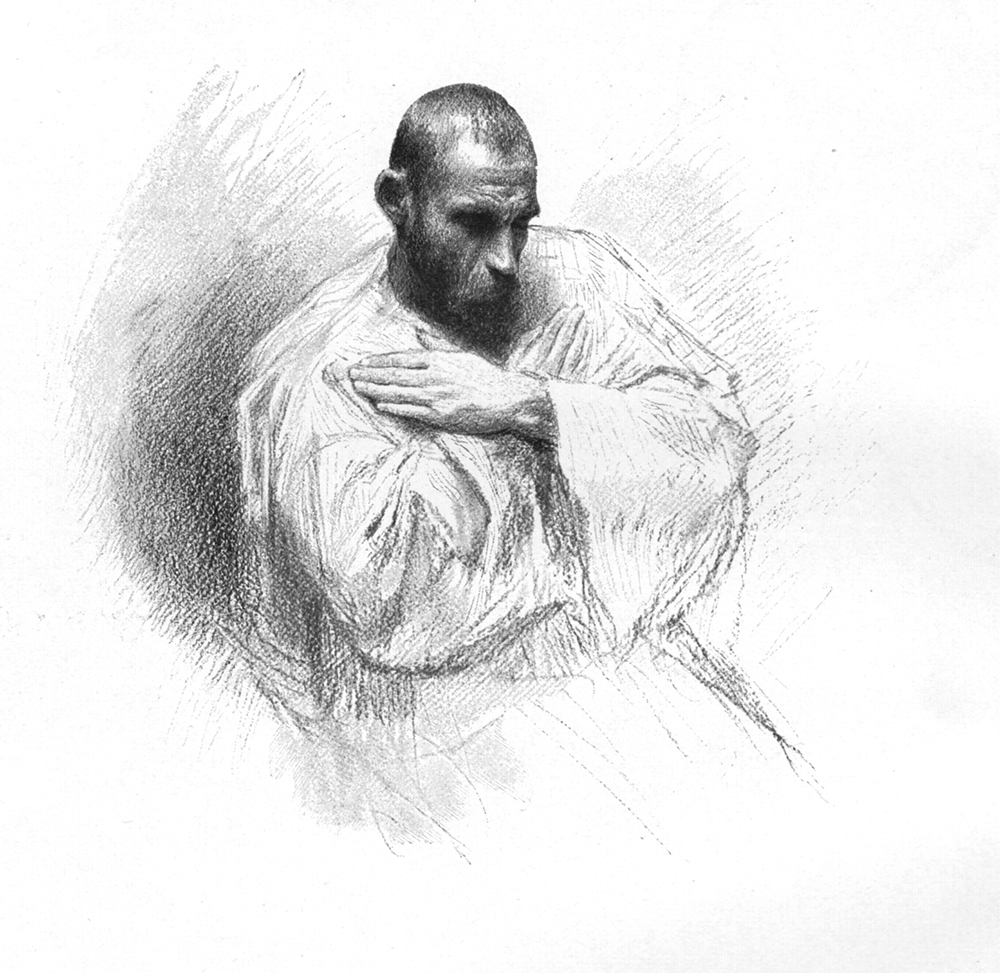
Art: Eugene Burnand, 1850-1924, litho; Scripture used here is from the Living Bible.

Meet the Older Brother

Luke 15:25-32

25-27 “All this time his older son was out in the field. When the day’s work was done he came in. As he approached the house, he heard the music and dancing. Calling over one of the houseboys, he asked what was going on. He told him, ‘Your brother came home. Your father has ordered a feast—barbecued beef!—because he has him home safe and sound.’

28-30 “The older brother stomped off in an angry sulk and refused to join in. His father came out and tried to talk to him, but he wouldn’t listen. The son said, ‘Look how many years I’ve stayed here serving you, never giving you one moment of grief, but have you ever thrown a party for me and my friends? Then this son of yours who has thrown away your money on whores shows up and you go all out with a feast!’

31-32 “His father said, ‘Son, you don’t understand. You’re with me all the time, and everything that is mine is yours—but this is a wonderful time, and we had to celebrate. This brother of yours was dead, and he’s alive! He was lost, and he’s found!’”

I hated him. I know I shouldn’t but I did. He betrayed all of us by his nonsense. It all started when he demanded that our father immediately divide up our inheritance. Strange I know. It was a shock, like a punch in the stomach. No one knew what to say, it was so bizarre. I have no idea where this idea came from.

He insisted that we divide things up right this instant. He didn’t have the decency to wait for our father’s funeral. It was such a shameful thing that I couldn’t begin to tell you how mortified I was. No one ever heard of anything happening like this before. Even now, after these many years, I can hardly talk about it.

My father simply did what was asked, there was no argument, no resistance.

The property was appraised, and the money was divided up according to custom. We sat at the kitchen table, and the ass watched to make sure that he received every penny that was coming to him. His hungry greed was beyond belief. He oozed arrogance–it was then I really began to hate him.

Never ever had I been so angry and ashamed.

My younger brother never even batted an eye and my father simply did what was asked. My brother didn’t even have the decency to say “thank you.” I desperately wanted to leave, and I couldn’t. I had to be there, and I felt like I was going to throw up.

Enough of that. Let’s move on.

That ass, my younger brother packed up and left. Occasionally I heard of his escapades. There were awful reports of his drunkenness and whoring. He was spending our father’s money as if it would never going to run out. Even talking about it now makes me angry.

The last I had heard was he was now feeding pigs. He had spent every last dime and now it seems he was getting what he deserved. I didn’t shed a tear, I felt no pity. Good, he was getting what he should of gotten all along. I only wished that things would get even worse.

Coming in from the fields I heard a raucous party coming from the house.

I asked one of the servants what was going on. When they told me I was even more shocked. Our father had arranged a celebration, all because my brother had returned. The fatted calf had been killed, the one that was saved for parties, and I heard shouts of joy and dancing. They were celebrating, and that made no sense to me at all.

I had served the estate faithfully, I had sweated to make things work, and I never got a party like this.

My father came out to find me, I had hid out in a shed–I didn’t want to be a part of this awful charade. When he found me he said that the party had to happen. It seems the scoundrel had the audacity to return–the money was spent, and apparently, he came home in rags–it served him right. He got what he deserved.

He told me about the necessity of this celebration.

My mind reeled. Could things get even crazier? Never had I heard of anything so bizarre. It was beyond belief. My father wanted me to come in and join them; I’d rather die. You have no idea.

He kept telling me that this had to happen–apparently he was given a new robe, and worst of all he was given the family ring, the ring that declared that he was now a full-fledged son, someone who could have all of the privilege and authority of a son. I had never heard of such foolishness.

My father said this was necessary, that my brother who I hoped was dead, was now alive.

How bad could things get? Perhaps my father had lost his mind.

“Just so, I tell you, there will be more joy in heaven over one sinner who repents than over ninety-nine righteous persons who need no repentance.”

Luke 15:7

Painting: “The Return of the Prodigal Son by Rembrandt, c. 1667, oil on canvas. This picture shown is a small part. Scripture is The Message, a translation by Eugene Peterson.

Meet Matthew, (also known as Levi)

Mark 2:13-14

“Then Jesus went out to the seashore again and preached to the crowds that gathered around him. 14 As he was walking up the beach he saw Levi, the son of Alphaeus, sitting at his tax collection booth. “Come with me,” Jesus told him. “Come be my disciple.”

“And Levi jumped to his feet and went along.”

My name is Levi, and I once collected taxes for Rome. It was a good living–it’s funny, but my parents chose my name– “Gift of God.” They were pious Jews who dreamed I would be more than I was. I sometimes wonder. Did they understand what Jesus was calling me to become?

As a tax collector, I was considered unclean. A small step above a leper I guess. The Temple was off-limits for me; I never had any sacrifice for my many sins. I carried my guilt like a heavy jacket on a hot day–some would say that God turned his back on me. I was seen as a collaborator, a betrayer of my people.

Do you know what it’s like to be damned?

My friends were sinners like me. In some dark way, we understood each other, we were all outcasts. Some of us were drunkards and whores, others were thieves and scoundrels, all of us were undesirable. They say that misery loves company–and we all were very much lost.

My tax booth was situated at a crossroads, it was ideal for collecting taxes. No one carrying goods could come by without paying me. Over time I became wealthy, and that was very good, for me anyway. But, I must admit at times that it was very hard. I wondered if that was all my life was good for, collecting coins for Rome.

Jesus was teaching near my booth, I listened to Him, and that was a good thing. But when He passed by me my mind and heart finally came together. I both felt and knew that there had never ever been someone like Him. I prided myself as a good judge of character–my business taught me that. But I realized exactly who He was.

He stopped right in front of my booth.

Jesus looked hard at me. I felt His eyes searching and I realized that He seemed to look right through me. I guess He knew exactly who and what I was all about, and it unnerved me, but in a good way. I wasn’t seeing Him, rather it was He that saw me.

Jesus’ words were a lightning bolt. “Come, follow me.” And suddenly all I attained in my business was a pile of nothingness. I can never get over the shock of those words– Jesus, the Messiah wanted me. What those words meant was non-negotiable. He had put His call on me, someone who was very much lost.

What could I say–what could I do?

To follow was not optional. I saw the silver and gold and realized they meant nothing. I left the coins on the table and I started to live a life that really mattered. I have never doubted or questioned that moment. What could I do, but follow Him?

We had a going-away party that night and I invited all my “disreputable” friends. Jesus shared many wonderful things with us. We had never had anyone who really cared for us like Him. We had never experienced this before.

The Pharisees were incensed. They began to rebuke Jesus for setting down to eat and fellowship with us. In their minds my home was unclean–we were all unclean. But that was not the way of Jesus. He loved us when nobody else would.

“When Jesus heard what they were saying, he told them, “Sick people need the doctor, not healthy ones! I haven’t come to tell good people to repent, but the bad ones.”

Mark 2:17

Art: Wautier, Carel; The Calling of Saint Matthew,” c. 1650