The Blessing of the Children

Luke 18:15-17, KJV

15 “And they brought unto Him also infants, that He would touch them; but when His disciples saw it, they rebuked them.

16 But Jesus called them unto Him and said, “Suffer little children to come unto Me, and forbid them not, for of such is the Kingdom of God.

17 Verily I say unto you, whosoever shall not receive the Kingdom of God as a little child shall in no wise enter therein.”

Again we were wrong (like usual it seems). I guess that we were trying to maximize Jesus’ ministry. We meant well, but He needed organization. So that was now our “ministry.” We simply felt that Jesus’ time was our concern, and as His disciples we wanted Him to connect with those who really mattered.

The parents were bringing their children to be blessed by Jesus.

“It was the custom for mothers to bring their children to some distinguished Rabbi on the first birthday that he might bless them.”

William Barclay

Jesus made it clear that these children needed to be the focus of our ministry. Our efforts were not to be centered on adults, rather it was misguided thinking that we direct Jesus’ work to be focused and redirected. These little ones were in the way.

Up to now, Jesus’ work was for adults. There were lepers, demon-possessed, paralyzed, tax-collectors all waiting for His ministry. Somehow we overlooked the needs of little children. Again, we were wrong, misguided, and ignorant of the walk of the true believer.

And sure enough, Jesus explained what we were missing. Children were to become our focus. They were the ones who we were to emulate and esteem. The radical thing to us was understanding that these ‘little ones’ were that significant.

I must say that this was a powerful jolt.

“Let these children alone. Don’t get between them and me. These children are the kingdom’s pride and joy. Mark this: Unless you accept God’s kingdom in the simplicity of a child, you’ll never get in.”

Luke 18:16-17, The Message

This was astounding! It was nothing less than another radical thought from our Teacher. Accepting this wasn’t easy, but Jesus was crystal clear. We dare not think otherwise, but to believe this was against all we thought we understood.

Jesus understood that childlikeness was the only way we could enter His Kingdom.

Trust me on this–we believed otherwise. Up to now, we assumed that maturity meant sophistication. It was all about right thinking and good theology that God was looking for. We assumed that being simple wasn’t quite what Jesus wanted from us. Rather we believed the opposite.

Children were now to be our examples. Their simpleness was to be our guide–it was the Kingdom of God’s doorway into true discipleship.

“Part of the exquisite beauty of salvation is its simplicity. Any man, woman, or child can come to Christ with absolutely nothing to offer Him but simple faith-just as they are. Salvation requires nothing more than childlike faith-believing that Jesus Christ died for my sins and accepting His gift of Salvation.”

Beth Moore
Discipleship Can Hurt

Luke 9:57-62, NIV

57 As they were walking along the road, a man said to him, “I will follow you wherever you go.”

58 Jesus replied, “Foxes have dens and birds have nests, but the Son of Man has no place to lay his head.”

59 He said to another man, “Follow me.”

But he replied, “Lord, first let me go and bury my father.”

60 Jesus said to him, “Let the dead bury their own dead, but you go and proclaim the kingdom of God.”

61 Still another said, “I will follow you, Lord; but first let me go back and say goodbye to my family.”

62 Jesus replied, “No one who puts a hand to the plow and looks back is fit for service in the kingdom of God.”

There’s to be no whitewashing the way of discipleship–there’s no glamour, no special recognition–no acclaim in it. I guess this is the “real” way of being His follower. The path Jesus has for me demands I give Him my whole heart. Heart enough to turn it all to Him. Heart enough to give Him total commitment.

Jesus seems to make it hard–we can see this in His responses to each prospective disciple. His statements to each possible follower seem harsh, difficult, and a bit “unreasonable,” but He doesn’t receive these men unless they do what He says.

Discipleship demands that we give up what we hold dearest.

What happened to these three “would-be” followers? Did they return home dejected and frustrated? To follow in Jesus’ footprints means we give up our personal agendas, and turn our backs on what is closest and dearest. We must renounce everything, and give Him preeminence over all.

These are hard verses with profound implications. But this passage is given to us for a reason. We dare not minimize what it means to be a disciple. We must grasp the plow with both hands, and we can’t look back.

“Christianity without discipleship is always Christianity without Christ. Unless he obeys, a man cannot believe.”

    Dietrich Bonhoeffer

Meet the Centurion and Discover Real Faith

Matthew 8:5-13

 When Jesus had entered Capernaum, a centurion came to him, asking for help. “Lord,” he said, “my servant lies at home paralyzed, suffering terribly.”

Jesus said to him, “Shall I come and heal him?”

The centurion replied, “Lord, I do not deserve to have you come under my roof. But just say the word, and my servant will be healed. For I myself am a man under authority, with soldiers under me. I tell this one, ‘Go,’ and he goes; and that one, ‘Come,’ and he comes. I say to my servant, ‘Do this,’ and he does it.”

10 When Jesus heard this, he was amazed and said to those following him, “Truly I tell you, I have not found anyone in Israel with such great faith. 11 I say to you that many will come from the east and the west, and will take their places at the feast with Abraham, Isaac and Jacob in the kingdom of heaven. 12 But the subjects of the kingdom will be thrown outside, into the darkness, where there will be weeping and gnashing of teeth.”

13 Then Jesus said to the centurion, “Go! Let it be done just as you believed it would.” And his servant was healed at that moment.

Obedience had been ingrained in me. I understood authority and submission to my superior officers. It’s called “the chain of command” and it’s the reason why armies function the way they do. I ultimately acceded my will to my superior, who’s under authority himself. I also have soldiers who I command. I led over 100 men as the occupying force in Palestine.

We were hated and despised.

My servant was sick, and I knew that he was suffering greatly, but I had run out of options. My servant was the only family I was allowed to have. Since I served as a centurion I was not allowed to have a wife for the duration of my service. Over the years I’ve kept good and trustworthy servants with me–these men were very dear to me. They became my family.

I certainly was aware that both my men and I lived in constant danger from radical Jews.

I had exhausted all my efforts to bring some relief and healing to him–and it seemed to be getting worse, not better. My “contacts” told me of an itinerant teacher who had a reputation as a healer. It seems Jesus had a large following and I realized that He could be my last option.

So I went to Him for help and Jesus responded. But He wanted to go with me to my home. His willingness to come encouraged me, but I simply couldn’t allow that. Jesus’ visit would’ve made Him ceremonially unclean–I was a Gentile, a “dog.”

My home was off-limits.

But I did understand something. I was under authority as an officer in the Roman army, and my men also took orders. Obedience meant survival in a hostile environment like Judea. Our entire unit was drilled constantly and we all understood the need for a “chain of command.” Each of us obeyed our superiors. We had to.

With all this in mind, I asked Jesus to heal my servant with just a word.

He marveled at this. He said that my adherence to protocol was evidence of real faith. Those who were with Jesus were told something earth-shaking. My trust meant something, He made me an equal with the Israel patriarchs. My faith was to be emulated by the Jews.

He then told His followers that my confident trust was respected and acknowledged as evidence of God’s favor.

Simply, Jesus spoke a word and when I returned home my servant would be healed. I returned home to find him healthy.

“Christ will always accept the faith that puts its trust in Him.”

    Andrew Murray

Please visit my new site, alaskabibleteacher.com. If you liked this teaching, I really think you like this one too.

Meet the Man at the Pool

John 5:1-9

1-6 Soon another Feast came around and Jesus was back in Jerusalem. Near the Sheep Gate in Jerusalem there was a pool, in Hebrew called Bethesda, with five alcoves. Hundreds of sick people—blind, crippled, paralyzed—were in these alcoves. One man had been an invalid there for thirty-eight years. When Jesus saw him stretched out by the pool and knew how long he had been there, he said, “Do you want to get well?”

The sick man said, “Sir, when the water is stirred, I don’t have anybody to put me in the pool. By the time I get there, somebody else is already in.”

8-9 Jesus said, “Get up, take your bedroll, start walking.” The man was healed on the spot. He picked up his bedroll and walked off.

9-10 That day happened to be the Sabbath. The Jews stopped the healed man and said, “It’s the Sabbath. You can’t carry your bedroll around. It’s against the rules.”

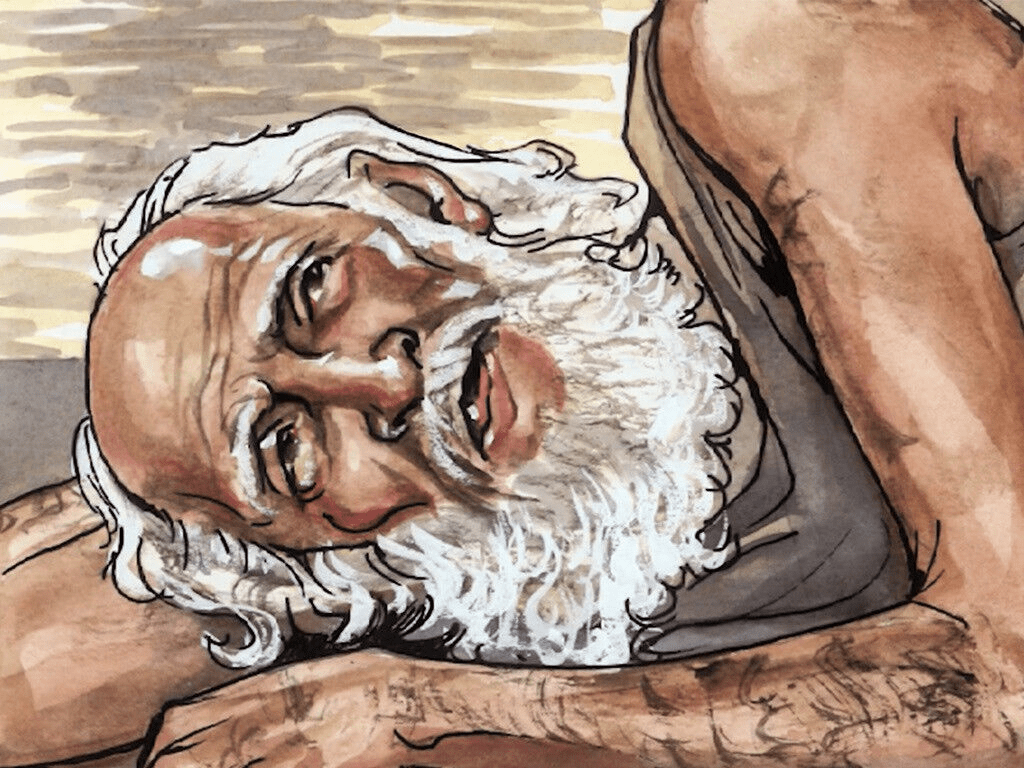
There were hundreds of us, surviving in our own personal man-made hell. We were the blind and the lame; simply dropped off by our families here to exist, to somehow make it on our own. We were a desperate lot, but there was a strange camaraderie, we all understood that our condition was hopeless. We were just marking time–and my 38 years was a lifetime for some. It’s a very long time to be sick.

None of us were whole, not by a long shot, otherwise, why were we sitting here waiting to die?

It’s said by some that an angel would venture down from heaven, and stir the pool–and the first to get in the water would be healed. It was one of those strange things that kept us from going crazy–a mental mechanism that bruised hearts often carry deep inside. It was a necessary way to keep from being lost.

I lived with my friends on these hard stone steps all these years, I’ve seen some live, and many more die. Banding together we became a community of survivors. We understood each other, and we knew everyone’s story–what else was there to do but talk?

It’s funny how some ideas get started–a silly dream, or a fairy tale of leaving this pool and becoming normal again. We developed the knack of a gallows kind of humor, a bond that condemned men shared with each other. We bantered these in order to cope with this slow-motion death. These were inside jokes, mixed with hefty dollops of half-believed hope and odd humor that only dying men learn to appeciate.

But maybe it kept us alive for just one more day. Perhaps it helped us to survive this hell.

That day started like 13,879 days before, and there was nothing unusual about it. There was nothing but the growing heat, the flies, and the sour smell of unwashed bodies. But in an instant, my life was going to be decisively interrupted. And at the time I never saw it coming.

Jesus threaded His way through the sitting bodies to find me.

When our eyes met he stopped. All He did was to ask me simply— “Do you want to be made well?” That question cut through the many years of accrued pain. I mumbled something about the angel, and the pool, and not having anyone to help me into the water. His question pretty much unraveled me. It seemed like it was just Him and me, staring at each other.

He told me to stand, to pick up my mat, and walk.

All of those half-baked days of a wasted life crashed in on me then. I saw all the emptiness and sadness of 38 long years. But in an instant, He healed me. I stood and picked up my mat, I shook my head and cried. Through my tears, I saw my friends looking at me in shocked and total amazement.

I simply walked out of there, carrying the only thing I owned.

“Then the lame will leap like a deer,
and the tongue of the mute will sing for joy,
for water will gush in the wilderness,
and streams in the desert.”

Isaiah 35:6, CSB

Art: Free Bible Images, text used is from The Message, a translation by Eugene Peterson

Meet Matthew, (also known as Levi)

Mark 2:13-14

“Then Jesus went out to the seashore again and preached to the crowds that gathered around him. 14 As he was walking up the beach he saw Levi, the son of Alphaeus, sitting at his tax collection booth. “Come with me,” Jesus told him. “Come be my disciple.”

“And Levi jumped to his feet and went along.”

My name is Levi, and I once collected taxes for Rome. It was a good living–it’s funny, but my parents chose my name– “Gift of God.” They were pious Jews who dreamed I would be more than I was. I sometimes wonder. Did they understand what Jesus was calling me to become?

As a tax collector, I was considered unclean. A small step above a leper I guess. The Temple was off-limits for me; I never had any sacrifice for my many sins. I carried my guilt like a heavy jacket on a hot day–some would say that God turned his back on me. I was seen as a collaborator, a betrayer of my people.

Do you know what it’s like to be damned?

My friends were sinners like me. In some dark way, we understood each other, we were all outcasts. Some of us were drunkards and whores, others were thieves and scoundrels, all of us were undesirable. They say that misery loves company–and we all were very much lost.

My tax booth was situated at a crossroads, it was ideal for collecting taxes. No one carrying goods could come by without paying me. Over time I became wealthy, and that was very good, for me anyway. But, I must admit at times that it was very hard. I wondered if that was all my life was good for, collecting coins for Rome.

Jesus was teaching near my booth, I listened to Him, and that was a good thing. But when He passed by me my mind and heart finally came together. I both felt and knew that there had never ever been someone like Him. I prided myself as a good judge of character–my business taught me that. But I realized exactly who He was.

He stopped right in front of my booth.

Jesus looked hard at me. I felt His eyes searching and I realized that He seemed to look right through me. I guess He knew exactly who and what I was all about, and it unnerved me, but in a good way. I wasn’t seeing Him, rather it was He that saw me.

Jesus’ words were a lightning bolt. “Come, follow me.” And suddenly all I attained in my business was a pile of nothingness. I can never get over the shock of those words– Jesus, the Messiah wanted me. What those words meant was non-negotiable. He had put His call on me, someone who was very much lost.

What could I say–what could I do?

To follow was not optional. I saw the silver and gold and realized they meant nothing. I left the coins on the table and I started to live a life that really mattered. I have never doubted or questioned that moment. What could I do, but follow Him?

We had a going-away party that night and I invited all my “disreputable” friends. Jesus shared many wonderful things with us. We had never had anyone who really cared for us like Him. We had never experienced this before.

The Pharisees were incensed. They began to rebuke Jesus for setting down to eat and fellowship with us. In their minds my home was unclean–we were all unclean. But that was not the way of Jesus. He loved us when nobody else would.

“When Jesus heard what they were saying, he told them, “Sick people need the doctor, not healthy ones! I haven’t come to tell good people to repent, but the bad ones.”

Mark 2:17

Art: Wautier, Carel; The Calling of Saint Matthew,” c. 1650

Meet Martha

Luke 10:38-42

38 While they were traveling, he entered a village, and a woman named Martha welcomed him into her home. 39 She had a sister named Mary, who also sat at the Lord’s feet and was listening to what he said.40 But Martha was distracted by her many tasks, and she came up and asked, “Lord, don’t you care that my sister has left me to serve alone? So tell her to give me a hand.”

41 The Lord answered her, “Martha, Martha, you are worried and upset about many things, 42 but one thing is necessary. Mary has made the right choice, and it will not be taken away from her.”

Mary wasn’t lazy–I knew that. I saw her sitting at Jesus’ feet, listening to his every word. Perhaps I was jealous, I don’t know. And maybe I knew that I belonged there, to absorb his teaching and those wonderful parables. Looking back at it all, I should have been there too. It was a missed opportunity.

But there was so very much to do.

Jesus was in my home and all the disciples as well. I needed my younger sister’s help. There was cleaning to do. Bread must be baked, olives and figs needed to be washed, cucumbers and melons sliced up. The lamb must be cooked. There wasn’t enough time for me to do this work.

Mary did nothing. She needed to help me, and that was our priority. After all, teaching was for the men, that’s how it was supposed to work. My sister was definitely not pulling her weight. We needed to serve all of these men–they were counting on us.

We should be serving, not sitting.

For a while, I bit my tongue. But I was getting more and more frustrated with her. Couldn’t she see? Why did I have to do all the work? Finally, it had to boil over. I went to Jesus to intervene in Mary’s foolishness. Surely He would do something. He would surely understand my predicament.

“Sir, doesn’t it seem unfair to you that my sister just sits here while I do all the work? Tell her to come and help me.”

I’ll never forget what He said to me. He was kind and loving, the rebuke didn’t originate with Him. It came from inside me. At that moment I knew that my priorities were very wrong–

“Martha, dear friend, you are so upset over all these details! There is really only one thing worth being concerned about. Mary has discovered it—and I won’t take it away from her.”

There are those times when everything becomes crystal clear. Mary was right where she was supposed to be. Jesus knew my anxiety. He completely understood my question, and I knew He was totally aware of me. His word of gentle correction nailed me.

Truly Mary had discovered God’s will, and I had not.

In all my labor I had forgotten what was truly important. Jesus’ words saved me from me. I wasn’t called to work hard; I was called to just sit, next to my sister, listening to the words of my master.