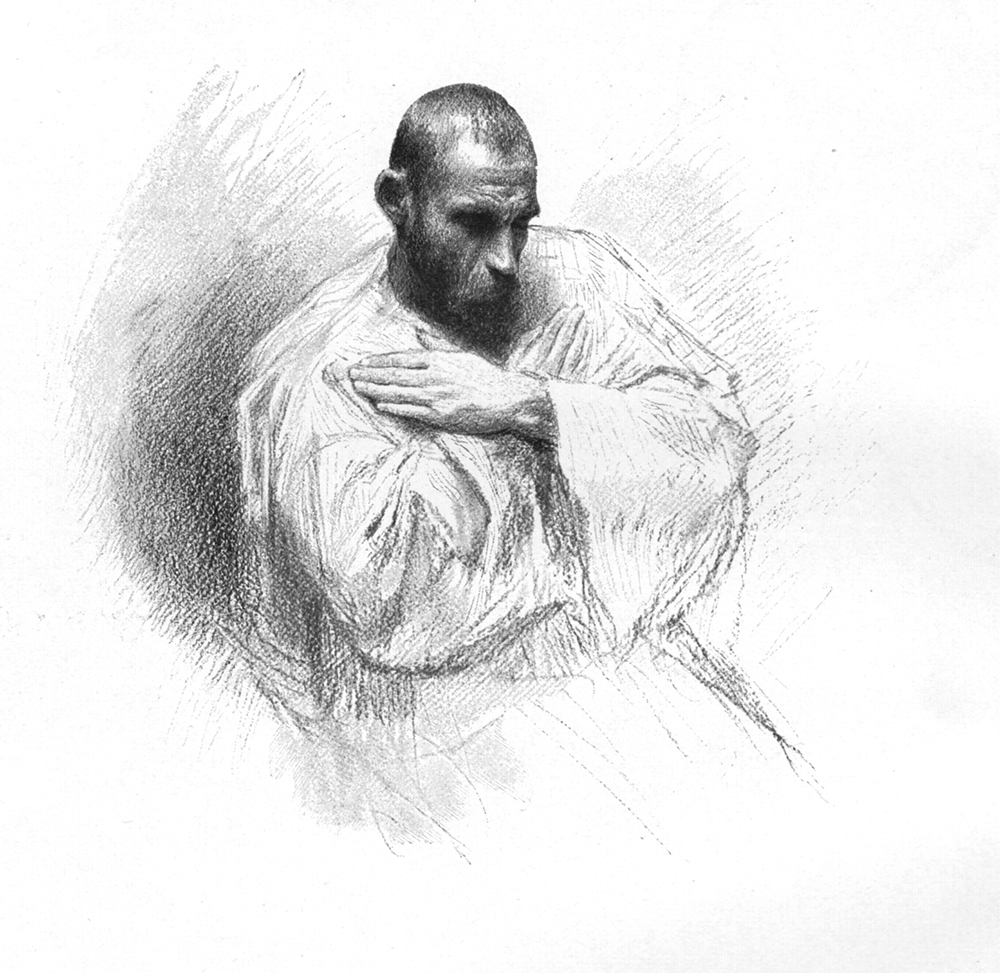
The Sword Meets the Ear of Malchus

Luke 22:49-51, CSB

“When those around Him saw what was going to happen, they asked, “Lord, should we strike with the sword?” 50 Then one of them struck the high priest’s servant and cut off his right ear.

51 But Jesus responded, “No more of this!” And touching his ear, he healed him.

How should we proceed with this? Perhaps we should start with the garden of Gethsemane. The setting explains a lot. Jesus is praying alone and He asks His Father for the strength to make it to His cross. It’s said that at that He sweated out what was like drops of blood.

The usual way of praying for a Jewish man was standing, but here we read that Jesus was on His knees. We also read that an angel showed up–it says that this angel came with strengthening power. The Greek word for “strengthen” can mean to invigorate. I believe Jesus’ prayer was answered (but not the way He wanted).

Jesus now had the strength to stand up and face the terror of the cross.

Judas led the mob that came to arrest Jesus. There was the kiss of betrayal and I suppose that the torchlight wasn’t really enough to identify Jesus outright. Judas’ kiss goes into the history books as the ultimate act of a traitor. It’s probably the most wicked kiss ever given to another.

What happens next seems to come out of an R–rated movie script. Peter takes up a sword and slashes and connects with a guy named Malchus who was the servant of the high priest. An ear is chopped off and Peter has a bloody sword, but not so fast. Jesus insisted that this is not the way of a true disciple.

Some would suggest that having good swordsmanship is a vital characteristic of a follower of Jesus.

But I don’t think so.

Jesus stops the whole scene to pick up Malchus’ ear and reattach it. Peter is definitely rebuked (notice the exclamation mark in verse 51)! Being a believer means following Jesus to the garden, and then the cross. Often we look at anything that avoids these places. When we’re truly following Him we are commanded to take up our own cross daily.

“When the Church takes sword in hand, it usually shows that it does not know how to wield it, and as often as not has struck the wrong man.”

Maclaren

Malchus plays such a minor role, and yet the ear amputation speaks volumes. We discover that the implications clarify the Lord’s desire for His followers–something that makes it clear that, “His ways are not our ways.”

Even in the garden, facing arrest and torture, Jesus is still reaching out to those around Him. Malchus is Jesus’ last ‘physical’ healing of another–He is kind and merciful, and He shows us how to love our enemies.

Today is Maundy Thursday. Tomorrow the pain of the cross. But He’s in the garden now, and recognizes exactly what is going down. “But this is your hour, and the power of darkness.”

“You have heard that it was said, ‘You shall love your neighbor and hate your enemy.’ 44 But I say to you, Love your enemies and pray for those who persecute you,”

Matthew 5:43-44

Jesus and the Cliff

Luke 4:28-30, CSB

” When they heard this, everyone in the synagogue was enraged. 29 They got up, drove him out of town, and brought him to the edge of the hill that their town was built on, intending to hurl him over the cliff. 30 But he passed right through the crowd and went on his way.”

When I pastored a church, I loved it when people told me that my sermon was the best they’ve ever heard. What a boost! But Jesus didn’t have that response when He preached at the synagogue in His hometown. The people went nuts! They weren’t happy with what Jesus had to say.

Nazareth was big enough (500 people) to have its own synagogue. This was the central place in the town. The village was also built very near to a sizable cliff. (You can see it today.)

It wasn’t a nicey-nice sermon, and it certainly didn’t comfort the congregation. They got really angry–Jesus point-blank confronted them. I suppose the Jewish leaders may have incited the crowd, which is sort of typical. If we take a quick peek at what He said perhaps we can understand their response (Luke 4:23-27).

But it’s really odd, initially, the people were responsive:

“They were all speaking well of him and were amazed by the gracious words that came from his mouth; yet they said, “Isn’t this Joseph’s son?”

(v. 22)

Two things immediately strike me, maybe they’re significant, and maybe not. One–This attempt to toss off the cliff came immediately after Jesus’ temptation. (One of Satan’s temptations was Jesus jumping off the pinnacle of the temple.) Two–this is Nazareth, the town where He grew up, and the people obviously had issues about this ‘familiarity.’

They couldn’t or wouldn’t accept Him.

What probably happened is this. After Jesus’ sermon, the people were enraged. They escorted Him, pushing and shoving to the cliff. Throwing Jesus off was just the beginning, as He landed they would have gathered rocks (as big as a person’s head) and they would’ve finished the deed by stoning Him. They would have aimed at His chest first, and then the head. Survival was unlikely.

Prophets and teachers are seldom respected by who is closest to them. (Trust me, I know all about this.) Joseph, Jesus’ step-dad (if he was alive) would’ve had a carpentry shop. And Mary would’ve shopped with the women of the village. Both would have been in the synagogue and part of the crowd.

So tell me. What lesson can we grasp from this passage?

We’re people who’ve got the ability to make choices. Stoning is frowned upon in our culture; but could it be that we respond to Jesus’ words in less extreme ways? Physically we can’t react like this. But could it be we ignore Him or are apathetic to the things He says to us? Might this be as “bad” as stoning? (Maybe I’m putting too fine a point on it?)

The Lord Jesus’s voice to us should never be trifled with.

The things He speaks are supremely authoritative–what He shows us is not a trivial thing. His words are always significant. What Jesus says to us mustn’t be ignored, no matter what they communicate.

As believers or nonbelievers, we must take into our hearts the word that He speaks. To minimize or nullify (by our apathy?) is incredibly dangerous. When we judge Him we’re actually judging ourselves, and that dear one is frightening. We make the decision to accept or reject Him. It’s that freedom of choice that can be scary.

What has Jesus spoken to you that you’re turning a blind eye to?

Is it possible He has spoken but you’re ignoring Him? I mean no harm and it’s not possible for me to know your heart. But maybe you’ve listened up to a certain point and ignored the things that don’t settle with you. Personally, when I read Jesus’ words in the Gospels I discover an awful lot that I don’t really want to hear. (He talks about humility and loving our neighbor before ourselves. Yikes!)

Please consider this honestly. It’s spiritually dangerous to be apathetic and not to pay attention to what you know to be the full Word of God.

“In all unbelief there are these two things: a good opinion of one’s self, and a bad opinion of God.”

    Horatius Bonar

Meet the Deaf and Mute Man

“Some people brought a man who could neither hear nor speak and asked Jesus to lay a healing hand on him. He took the man off by himself, put his fingers in the man’s ears and some spit on the man’s tongue. Then Jesus looked up in prayer, groaned mightily, and commanded, “Ephphatha!—Open up!” And it happened. The man’s hearing was clear and his speech plain—just like that.”

36-37 “Jesus urged them to keep it quiet, but they talked it up all the more, beside themselves with excitement. “He’s done it all and done it well. He gives hearing to the deaf, speech to the speechless.”

Mark 7:34-37, The Message

Jesus enjoyed carrying the good news to distant places. His ministry wasn’t confined. He went to places that orthodox people avoided. Jesus penetrated these places and found a rich mission field. (This should speak volumes to us.)

It was in Decapolis that He met this man. He was deaf and mute, and it seems no doctor could help him. Close friends brought this man to Jesus. They begged Jesus to heal him–perhaps this shows their faith and love. (Again this should speak to us. Do we care for others–or not?)

The Lord led this man away from the crowd (interesting.) It seems Jesus wanted privacy. I think that He wanted to avoid the “carnival” atmosphere that healing would cause. Jesus was God–not a showman. (This dear one should clarify things for us.)

It interests me the approach He took. Jesus’ fingers went into the man’s ears. He spits (!) and touched the man’s tongue with His saliva. (Oh if He could do this to us!) Jesus looked up to heaven and said one word, “Ephphatha!” Which in English means “be opened.”

The man suddenly began to speak!

Everyone who witnessed was amazed. Jesus looked at those and told them not to say a thing about what just happened. (Is this humility or what?) Of course, it interests me that the crowd ignored His command; they couldn’t help but spread the news. They must have figured that Jesus was the Messiah, and this miracle proved it.

But the way He went about this amazes me–why the fingers and obviously why the spit? Perhaps this man, (and his friends) needed to see something more “physical.” Maybe? Could it have communicated something to Jesus’ disciples who were watching? Could it be that this can guide us as we now carry Jesus’ power?

I’m thinking through these things.

One: Jesus does impossible things He extends Himself to the “unorthodox”

Two: He seems to heal in ways we really don’t quite understand.

Three: What Jesus does is not about “showmanship,” He avoids publicity and self-promotion.

And there must be other points. It’s good I think, to roll these thoughts around.

A Question: Am I Like Peter?

To follow Him can be really hard. There doesn’t seem to be any contingency plans for any who are looking to escape such a drastic call. Jesus either is, or He isn’t our Lord. “Do you also want to leave?” This is a question that will be asked to every disciple–sometimes once, and sometimes repeatedly.

There are these crystalline moments when I must make a decision. Will I take up my cross and go with Him? There doesn’t seem to be any room in Jesus’ band for ‘almost’ disciples. That scares me sometimes.

Today’s cross is waiting for me. I’m afraid at times that I won’t be able to take the next step as a true follower. Am I just fooling myself?

All of heaven seems to stand on tiptoe to see what I’m going to do next.

Who am I really?

Being obedient to Jesus is far from easy. We must have His Spirit.

“After this, many of his disciples left. They no longer wanted to be associated with him. Then Jesus gave the Twelve their chance:

“Do you also want to leave?”

“Peter replied, “Master, to whom would we go? You have the words of real life, eternal life. We’ve already committed ourselves, confident that you are the Holy One of God.”

John 6:66-69, The Message

Image from Wikipedia, verses are from The Message Bible by Eugene Peterson.

Meet the Widow, at the Funeral of Her Son

Luke 7:11-17

Not long afterwards Jesus went with his disciples to the village of Nain, with the usual great crowd at his heels. 12 A funeral procession was coming out as he approached the village gate. The boy who had died was the only son of his widowed mother, and many mourners from the village were with her.

13 When the Lord saw her, his heart overflowed with sympathy. “Don’t cry!” he said. 14 Then he walked over to the coffin and touched it, and the bearers stopped. “Laddie,” he said, “come back to life again.”

15 Then the boy sat up and began to talk to those around him! And Jesus gave him back to his mother.

16 A great fear swept the crowd, and they exclaimed with praises to God, “A mighty prophet has risen among us,” and, “We have seen the hand of God at work today.”

17 The report of what he did that day raced from end to end of Judea and even out across the borders.

My world crashed down around me. First, my husband, and then my only son are dead. I’m left absolutely alone, I have lost everything that really matters. I am penniless, without hope. Why has God treated me this way?

Am I being judged for my sins? Only God knows.

I live in Nain, which is a few miles south of Nazareth. It’s a village where everyone knows each other and it’s hard to be private. Everyone knew my situation. But that doesn’t make it any easier. Grief had become my constant companion, I knew it well. Psalm 88:18 became my deepest cry, I finally understood it.

The funeral procession began at my house and led to the cemetery. It was the same route we walked with my husband, and now today with the body of my only son. A large crowd escorted the coffin, but that brought me nothing but more pain.

They were a small comfort, but they changed nothing.

We arrived at the village gate at the same time as Jesus of Nazareth. He was accompanied by a large boisterous crown. There were suddenly hundreds of people converging at one spot. The crowds mixed with the mourners like two ocean currents that come together, hot and cold.

Jesus approached me.

He was deeply moved and there was incredible compassion on His face. “Please don’t cry,” He told me. Then he walked over to the coffin and the bearers stopped. Everyone in the crowd stopped and riveted their gaze on Jesus.

Jesus reached out and touched my son’s coffin.

“Boy, I tell you to wake up!” Suddenly, my son sat up and began to speak. My heart jumped in my throat as the bearers lowered the bier. “My son is alive!” I screamed, “Alive!”

Jesus led my son to me. I held him close and stroked his hair I couldn’t let him go. Suddenly everything changed. I knew God saw me and loved me. I have never been happier. I could never have dreamed something like this could happen to someone like me.

The crowd stood dumbstruck in the presence of Jesus. After a minute they began to murmur, “He is a prophet!” Others said, “God has visited His people.” People were hugging each other with complete abandon. All I could do is hold my precious son.

Tears, tears of joy rolled down my cheeks.

The news of my son’s resurrection spread throughout the entire region, and the popularity of Jesus skyrocketed. God was making Himself known through Jesus Christ; but more importantly, we knew He loved us The peace and hope were like medicine to a beaten-down people.

Lord of mercy, raise up all that is fallen inside of me. I can be so dead sometimes and your presence is what I need. Impart newness of life to my heart. Come and be with me. Amen.

Art by Pam Lucey. Scripture from the Living Bible, Tyndale House

Meet the Pharisee. Meet the Tax Collector

Luke 18:10-14

 “Two men went to the Temple to pray. One was a proud, self-righteous Pharisee, and the other a cheating tax collector. 11 The proud Pharisee ‘prayed’ this prayer: ‘Thank God, I am not a sinner like everyone else, especially like that tax collector over there! For I never cheat, I don’t commit adultery, 12 I go without food twice a week, and I give to God a tenth of everything I earn.’

13 “But the corrupt tax collector stood at a distance and dared not even lift his eyes to heaven as he prayed, but beat upon his chest in sorrow, exclaiming, ‘God, be merciful to me, a sinner.’ 14 I tell you, this sinner, not the Pharisee, returned home forgiven! For the proud shall be humbled, but the humble shall be honored.”

The Pharisee:

I had it all together. I had shaped myself to be the ultimate Pharisee–the Pharisees of the Pharisees. I understood the Law; I could quote whole books, forward and backward. I fasted twice a week, tithed everything, right down to my herbs and spices. I had it all together.

I made sure everyone saw my commitment.

I strenuously kept God’s Law. I was consumed by understanding it, I tried to grasp all its nuances and complexity. The 10 commandments were emblazoned on all that I did. I wanted everyone to know that I was one of “the pure ones,” for that was the meaning behind the word Pharisee. I knew that I was pure.

I went to the Temple every day to pray, I stood holy and set apart, standing before a real and holy God. I was always the truest example to the people of Israel. I always stood when I prayed, for I was completely committed to doing all that the Law demanded of me.

One day I saw a wicked man in God’s holy temple. I had to thank God that we were total opposites. He was a tax collector and an evil person. I really was nothing like him. I rejoiced that I had become a true example of a righteous man.

I knew I was righteous, and certainly not at all like that sinful tax collector.

———————-

The Tax Collector:

I didn’t have it all together. I understood this and was horrified that I had become so evil. I came to the Temple, driven by my guilt and shame–no one had to tell me this, for I knew my sin and I was deeply ashamed.

Why I came, I don’t know. I honestly didn’t belong here, and I kept a distance from the front. I guess that’s where I belonged. On the fringes before the Holy One. It seemed now that I was drawn to this place, and I’m still not sure why I came that day.

I knew that I breathed evil and had become evil.

I fell to my knees, and I begged God to forgive me. I saw the Pharisee standing in the presence of God, but I knew I wasn’t at all like him. He was righteous and I knew I was not. Oh, how I wanted God to forgive me for all the sins I had committed.

I must tell you that my spirit was in agony.

“Humble men are very fortunate!” he told them, “for the Kingdom of Heaven is given to them. Those who mourn are fortunate! for they shall be comforted. The meek and lowly are fortunate! for the whole wide world belongs to them.

Matthew 5:3-5, LB

Jesus clearly told us who was truly forgiven that day. When we think we have it all together, we’re deceiving ourselves.

Let’s not pretend otherwise, okay.

Art: Eugene Burnand, 1850-1924, litho; Scripture used here is from the Living Bible.