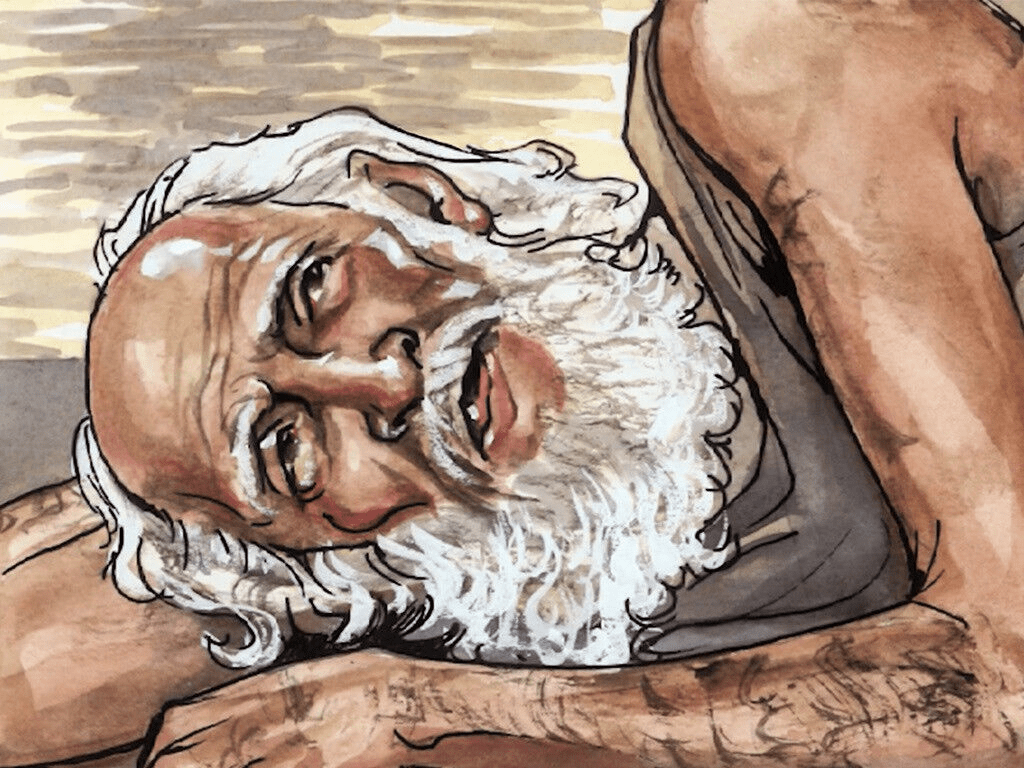
Meet Lazarus

John 11:25, 26; vv. 33-44

 25 Jesus said to her, “I am the resurrection and the life.[a] Whoever believes in me, though he die, yet shall he live, 26 and everyone who lives and believes in me shall never die. Do you believe this?” 27 She said to him, “Yes, Lord; I believe that you are the Christ, the Son of God, who is coming into the world.”

Jesus Weeps

When Jesus saw her weeping, and the Jews who had come with her also weeping, he was deeply moved[b] in his spirit and greatly troubled. 34 And he said, “Where have you laid him?” They said to him, “Lord, come and see.” 35 Jesus wept. 36 So the Jews said, “See how he loved him!” 37 

Jesus Raises Lazarus

38 Then Jesus, deeply moved again, came to the tomb. It was a cave, and a stone lay against it. 39 Jesus said, “Take away the stone.” Martha, the sister of the dead man, said to him, “Lord, by this time there will be an odor, for he has been dead four days.” 40 Jesus said to her, “Did I not tell you that if you believed you would see the glory of God?” 

 So they took away the stone. And Jesus lifted up his eyes and said, “Father, I thank you that you have heard me. 42 I knew that you always hear me, but I said this on account of the people standing around, that they may believe that you sent me.” 43 When he had said these things, he cried out with a loud voice, “Lazarus, come out.” 44 The man who had died came out, his hands and feet bound with linen strips, and his face wrapped with a cloth.

Jesus said to them, “Unbind him, and let him go.”

My name is Lazarus and I was a special “friend” of Jesus. We liked being with each other, and my sisters Mary and Martha also enjoyed fellowshipping with Him. Whenever He passed through Bethany, Jesus always had an open invitation to visit.

What’s it like to be dead? Many ask me this, and I suppose they want to understand, and I don’t blame them. To me, it seemed like a very deep sleep–but I didn’t dream. Those who look for any special insight, will not find it from me. And yet, I am His witness. He has incredible power over death.

I heard Him call my name.

It pierced through everything with an authority I’d never heard before. I had been laid in my tomb for 4 days and my physical body had begun to putrify. When they rolled the stone away the terrible smell of death lay heavy in the air.

I was tightly bound in cotton wraps and sticky spices had been applied to my body. Mary and Martha had objected to Jesus’ attempt. As I looked back I realize that their actions were justified. After all, who can give life when one is very much dead. And not only dead but well on the way on to decay. The smell wafted from my tomb.

I had heard His shout, and it was then death was reversed.

My heart and brain began to work again. When I came to I found that I was lying on a stone table and tightly wrapped in the clothes of the dead. I managed to sit up, and I shuffled toward the light that had entered the tomb by the stone that covered the door.

When Jesus saw me I believe that He was laughing. He gave the command to the shocked bystanders, He commanded them to unwrap me. I suppose that then I realized I was now in the land of the living. I can’t explain what had happened, But my grave clothes were unwrapped.

There were many that day that became believers.

Many had attested that I was most certainly dead, after all, they had attended my funeral. Some had observed that I had been slathered in the sticky ointment–fragrant spices. And a few were witnesses to see the stone rolled in place.

So many believed in Jesus’ power of resurrection that day–they were completely amazed and simply reacted to what Jesus had just done for me.

There were some who simply didn’t (or wouldn’t) believe.

There were the Pharisees and the Sadducees who wanted me dead hoping to nullify my witness and my resurrection from the dead.

Their hatred of Jesus’ ministry was only strengthened. My own resurrection proved His authority and power over even death. I was a walking and breathing miracle that they refused to accept. It got so bad that the religious leaders wanted to kill me because so many believed in my resurrection. I was a living witness to many.

Yes, I know that I’ll die again. But even now, in my second death, I’m not afraid anymore.

I had become an embarrassment to them, a constant reminder that Jesus had defeated death.

He alone can believe in immortality who feels the resurrection in him already.

Frederick W. Robertson

But some of them went away to the Pharisees and told them the things Jesus did. Then the chief priests and the Pharisees gathered a council and said, “What shall we do? For this Man works many signs. If we let Him alone like this, everyone will believe in Him, and the Romans will come and take away both our place and nation.”

John 11:53-54

Art: blogspot.com. Scripture: Christian Standard Bible, Holman Publishers; The Message, Eugene Peterson
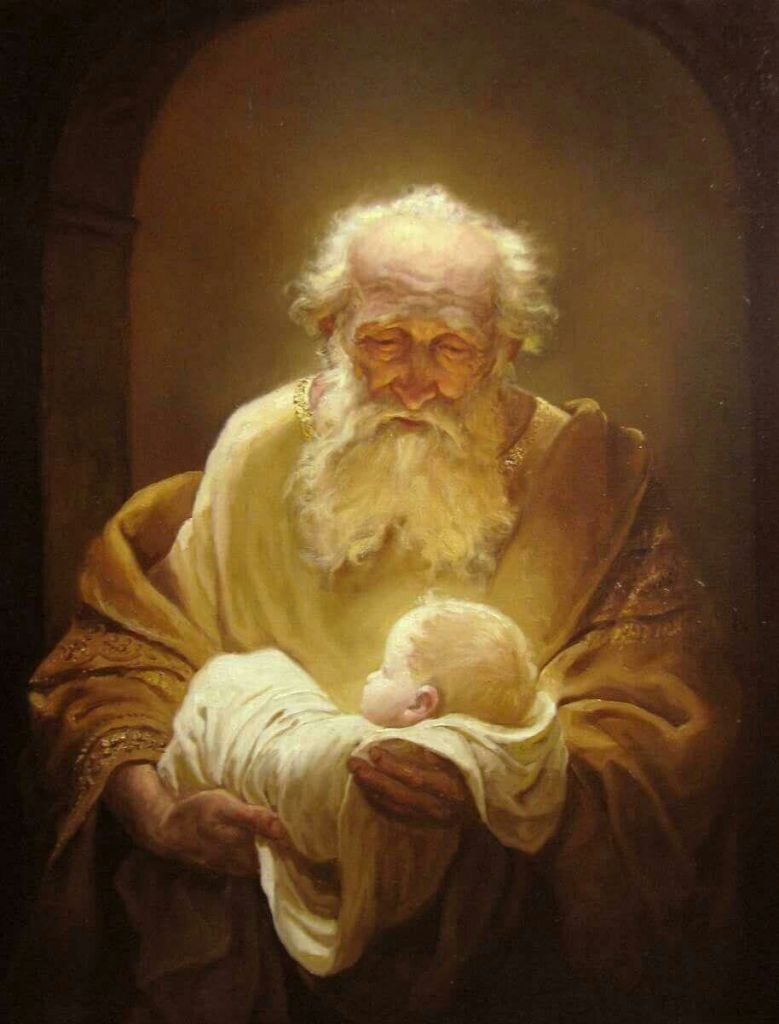
Meet Simeon in the Temple

Luke 2:25-35

There was a man in Jerusalem whose name was Simeon. This man was righteous and devout, looking forward to Israel’s consolation, and the Holy Spirit was on him. 26 It had been revealed to him by the Holy Spirit that he would not see death before he saw the Lord’s Messiah. 27 Guided by the Spirit, he entered the temple. When the parents brought in the child Jesus to perform for him what was customary under the law, 28 Simeon took him up in his arms, praised God, and said,

29 Now, Master,
you can dismiss your servant in peace,
as you promised.
30 For my eyes have seen your salvation.
31 You have prepared it
in the presence of all peoples—
32 a light for revelation to the Gentiles
and glory to your people Israel.

His father and mother were amazed at what was being said about him. 34 Then Simeon blessed them and told his mother Mary, “Indeed, this child is destined to cause the fall and rise of many in Israel and to be a sign that will be opposed— 35 and a sword will pierce your own soul—that the thoughts of many hearts may be revealed.”

Yes, there were rumors. The priest Zechariah had declared that his son would become the Messiah’s forerunner. And apparently, angels had visited shepherds in their fields. Each encounter had come exactly how it was foretold.

I’m convinced that the Holy Spirit led me there that day.

I have no doubt that He was guiding me to the Temple. God had promised me that I would see with my own eyes the coming Messiah. This One would be salvation and be a light to the Gentiles which would bring glory and honor to the Jewish nation.

If these were of God, there needed to be collaborating witnesses that would foretell His work. One or two might be a mere coincidence, but three were a definite declaration. Plus I knew that my own eyes would see Him face-to-face.

To be perfectly honest, I really didn’t know what I expected to see. But I knew God’s heart, and I wanted to do His will. Some might say I was a devout believer in Israel’s prophetic purpose. I knew and believed that.

I had God’s promise that I would see Him.

Something or someone was prompting me to the Temple. I guess I had a divine appointment to keep. God had given me His promise, and I knew I was where I was supposed to be. It seemed like I was always on the lookout for that fulfillment.

It was then I saw the Child.

His parents stood out like something fluorescent. It seemed as if they were color in a black-and-white world, and they held the baby who was going to change the world. When I saw them I knew that everything had fallen into place. I saw the promise and He had come to save the world.

I took Jesus and held Him in my arms.

I was holding the Savior! This baby was to save the entire world from their sins. The Law required me to dedicate Him to God. Who can say what that means? I was to devote Him to God’s purpose and plan. Who had this honor, and who can say that this was their privilege? I had been chosen to insert Him into the purposes of God.

Who can say that?

When I laid my hands on Him it was like touching lightning. I spoke the blessing, but I understood that there was something more. I looked at His mother and spoke. It was both a blessing and a warning. I understood what God wanted to say, and it was a word that Israel’s hope would also have a sting that His mother needed to understand.

When I left the three of them in the Temple courts I began to grasp the reality of it all. I spoke God’s heart to His mother Mary. She had to know and understand who this Child really was. For me my task was complete.

I had spoken, and now it was time to leave.

“In the last days the mountain of the Lord’s Temple
    will be the highest of all mountains.
It will be raised higher than the hills.
    There will be a steady stream of people from all nations going there.”

Isaiah 2:2

Art: “Simeon holding Jesus,” by Andrey Shishkin, painted in 2012, Oil on canvas © Andrey Shishkin.

Verses used: Christian Standard Bible

Encountering the Feeding of the 5000

Luke 9:12-17

As the sunset, the Twelve said, “Dismiss the crowd so they can go to the farms or villages around here and get a room for the night and a bite to eat. We’re out in the middle of nowhere.”

“You feed them,” Jesus said.

They said, “We couldn’t scrape up more than five loaves of bread and a couple of fish—unless, of course, you want us to go to town ourselves and buy food for everybody.” (There were more than five thousand people in the crowd.)

But he went ahead and directed his disciples, “Sit them down in groups of about fifty.” They did what he said and soon had everyone seated. He took the five loaves and two fish, lifted his face to heaven in prayer, blessed, broke, and gave the bread and fish to the disciples to hand out to the crowd. After the people had all eaten their fill, twelve baskets of leftovers were gathered up.

Jesus had been healing many. Five thousand people sat enraptured by Jesus’ teaching. It was like nothing they had never heard before. It was definitely a testimony to Jesus’ fantastic presence. Where the all came from, I haven’t the slightest. To gather a crowd like this, in the middle of nowhere was amazing. None of us had ever heard of this ever happening.

Seventy of us had just returned from preaching ourselves, with stories of deliverance and healing. Herod had also heard, and that was a bit spooky. We certainly didn’t want his scrutiny, that’s for sure-I know he known about us.

It was getting dark and, quite honestly, we realized that we had a problem. We met with Jesus and expressed this development. We really didn’t have a solution. It came as a shock to us (and maybe absurd) that He told us to “feed them.”

The crowd concerned us.

After a search, we came up with five loaves and a few fish. We wanted Jesus to see the absurdity of this, and to emphasize the problem. Perhaps this meager discovery would help Him understand,

Jesus told us to reseat the crowds in groups of fifty, I’ve always wondered about that, but I suppose that He wanted to see the size of the crowd–and to oversee a better and more even distribution of the food. That was indeed wisdom, but it was far more than that.

He covered His head, looked to heaven to give thanks.

He then began to take the fish and bread to distribute to the crowds. I still don’t quite grasp what exactly happened. It still seems absurd.

The bread and fish just kept coming.

As we filled our baskets, the food never ran out! It just kept coming and coming! Our baskets were always full, and all 5000 were fed. As a matter of fact, everyone had more than they wanted–all from a measly five loaves and two fish!

And to emphasize all of this, each of us had our own baskets filled.

What happened then and there staggered us. Obviously, on a purely rational level, it was quite impossible. Surely Jesus had the ability to do anything He wanted to do. This miracle only confirmed the absolute power of Jesus–each of us had a full basket for ourselves. Jesus had made it clear that He was in full control of every situation.

Even now, how can we ever doubt Him?

“Don’t be afraid, little flock, because your Father delights to give you the kingdom.

Luke 12:32

For further reading: “Meet the Master of Ceremonies in Cana

Art is public domain, the passage is taken from The Message Bible by Eugene Peterson.

Mastered by Jesus

“A Christian is not a person who believes in his head the teachings of the Bible. Satan believes in his head the teachings of the Bible!”

“A Christian is a person who has died with Christ, whose stiff neck has been broken, whose brazen forehead has been shattered, whose stony heart has been crushed, whose pride has been slain, and whose life is now mastered by Jesus Christ.”

–John Piper

No longer do I call you servants, for a servant does not know what his master is doing; but I have called you friends, for all things that I heard from My Father I have made known to you.”

John 15:15

It seems that the purpose of life is not to find our freedom. It’s really meant to find our Master.

Yes, the idea of being a slave to anyone is repugnant. We chafe at this, and yet man was never meant to be seperated from the Lordship of Jesus. We’re instructed repeatedly with the New Testament idea that “our life is not our own”  Over and over God proclaims Himself as the King.

That troubles us somewhat.

Not so much when life is fairly good, granted, but in those hard moments when a decision must be made between enjoying the titillating “lusts of the flesh,” or accepting the fruits of the Spirit. This is one of those “lordship moments.” They come, and go, and they show us exactly who we are.

If you’re really going to be authentic–a legitimate and real disciple, then you must determine who is going to be “boss.” This isn’t one of those casual decisions. You must securely fix it in your heart.

Your decision must become a settled issue.

The thief on the cross knew salvation, he was promised an eternity with God simply by faith. But I submit to you that he had put himself under the Lordship of Jesus, simply by recognizing the sign, “the King of the Jews.” I believe he saw and understood its imlications. Jesus was King!

This is a very hard word for some, but many of our personal issues hinge on this.

I know this first-hand. It can be a monumental struggle. You must admit to not only having Jesus as your Savior, but you also must put your life under His total Lordship.  You need to pick up your cross daily in order to follow.  You need to learn how to kneel.

I’ve chosen a crown to open up this post–it’s done on purpose.  I simply want you to to understand the supreme call He has on your life. Here’s Bob Dylan, and he nails this idea down:

But you’re gonna have to serve somebody, yes indeed
You’re gonna have to serve somebody
Well, it may be the devil or it may be the Lord
But you’re gonna have to serve somebody

You must learn here and now how to kneel before the Sovereign King


Related: “Am I Like Peter”; “The Scum of the Earth;” “Those Strange Christians.”

A Question: Am I Like Peter?

To follow Him can be really hard. There doesn’t seem to be any contingency plans for any who are looking to escape such a drastic call. Jesus either is, or He isn’t our Lord. “Do you also want to leave?” This is a question that will be asked to every disciple–sometimes once, and sometimes repeatedly.

There are these crystalline moments when I must make a decision. Will I take up my cross and go with Him? There doesn’t seem to be any room in Jesus’ band for ‘almost’ disciples. That scares me sometimes.

Today’s cross is waiting for me. I’m afraid at times that I won’t be able to take the next step as a true follower. Am I just fooling myself?

All of heaven seems to stand on tiptoe to see what I’m going to do next.

Who am I really?

Being obedient to Jesus is far from easy. We must have His Spirit.

“After this, many of his disciples left. They no longer wanted to be associated with him. Then Jesus gave the Twelve their chance:

“Do you also want to leave?”

“Peter replied, “Master, to whom would we go? You have the words of real life, eternal life. We’ve already committed ourselves, confident that you are the Holy One of God.”

John 6:66-69, The Message

Image from Wikipedia, verses are from The Message Bible by Eugene Peterson.

Meet the Samaritan Leper

Luke 17:11-19

11-13 It happened that as he made his way toward Jerusalem, he crossed over the border between Samaria and Galilee. As he entered a village, ten men, all lepers, met him. They kept their distance but raised their voices, calling out, “Jesus, Master, have mercy on us!”

14-16 Taking a good look at them, he said, “Go, show yourselves to the priests.”

They went, and while still on their way, became clean. One of them, when he realized that he was healed, turned around and came back, shouting his gratitude, glorifying God. He kneeled at Jesus’ feet, so grateful. He couldn’t thank him enough—and he was a Samaritan.

17-19 Jesus said, “Were not ten healed? Where are the nine? Can none be found to come back and give glory to God except this outsider?” Then he said to him, “Get up. On your way. Your faith has healed and saved you.”

It’s said by many that “misery loves company.” So here we were, ten men banded together, each as lost and far gone as the other. Once our lives were whole and normal–wives and children, homes and jobs, but those wonderful things had been ripped away when we were told we had leprosy.

And basically, I was an outcast among outcasts. I was the sole Samaritan among Jews; not that it mattered anymore–those kinds of distinctions were no longer an issue between us. What we all were facing was a “slow-motion” death. There was absolutely nothing anyone could do, being a leper meant we were beyond any hope.

Do you have any idea what leprosy is?

It was the ultimate impurity–we were the bottom part of the “bottom of the barrel.” Every morning we sat down and unrolled our dirty bandages. We counted fingers and toes–and we examined each other’s faces noses, and ears. Leprosy numbs, the nerves become insensitive. Essentially we were rotting away before each other’s eyes.

We scavenged for food mostly, sometimes our families would set out baskets of bread and fish, maybe some wine we hoped. And sometimes they wrote us notes which could be both good and bad–they just reminded us that all we knew was gone. We would share these with each other, somehow we wanted and needed that bittersweet solace.

I believed that God, in His infinite wisdom, had cursed me.

We were the damned. Walking and talking zombies who were just waiting to die.

We talked among ourselves–the healings that Jesus was doing were fascinating to us. The blind received sight, demons were evicted, the crippled and lame now walked tall and whole. We joked about our little group meeting Jesus for ourselves, but we were imagining the impossible. When you’ve lost enough hope, black humor settles in to stay.

We somehow heard that Jesus was going to travel near us, so we walked to a hill by the road where we might see him come by. It seemed foolish, but it was better than just sitting. It would be good to see what the fuss was all about. We saw a group that was coming down the road–it was Jesus and his followers, so we waited.

“Jesus, Master, have mercy on us!”

Suddenly that became our desperate cry. Each of us stood and screamed out to Him in our lostness–that got His attention. He turned to look at us, and then declared these powerfully gentle and healing words, ““Go, show yourselves to the priests.” That was it, six words, no theatrics.

But as I said before, I was a spiritual outcast, a Samaritan, and going to the priests wasn’t possible. So instead I went directly to Jesus. You should have seen me, I was kneeling and shouting praises to God! Dear one, joy was an understatement–I was astonished at new hands and toes, ears and skin. Where there was once rotten flesh there was now fresh skin–baby soft and brand new.

I was now whole!

Where the nine others went, I don’t know. All I truly knew was that my leprosy was instantly gone.

Lord Jesus, you rule over all sickness and disease. I was like this leper, I had no hope, but you found me and set me free. You forgave my sin. Thank you for finding and healing me. Help me to follow you. Amen.

Image: CNN, Scripture “The Message, by Eugene Peterson.

Meet the Master of Ceremonies in Cana

John 2:9-10

When the master of ceremonies tasted the water that was now wine, not knowing where it had come from (though, of course, the servants did), he called the bridegroom over.

10 “This is wonderful stuff!” he said. “You’re different from most. Usually, a host uses the best wine first, and afterwards, when everyone is full and doesn’t care, then he brings out the less expensive brands. But you have kept the best for the last!”

Full account: John 2:1-10

I really don’t believe in miracles. But something happened when I was overseeing a wedding in Cana that I can’t explain. I’ve thought a lot about it and as I uncovered some of the details–well, part of me believes, and part of me can’t.

My duty was to oversee the details that are part of every wedding. That includes having a sufficient source of wine for the party. If I made a mistake or miscalculated the thirst of the guests, it’s the absolute worst thing I could do. Not too much wine (as it could be expensive) or not too little either. If I blew it, it would go down as a shameful thing.

Essentially I freed up the bride and the groom so they could enjoy their day–I handled all of the logistical stuff. It was my ministry you could say, I had a knack for managing these events, it was how I made my living. (It’s all about having a good reputation, and I suppose the shekels were also a part of my thinking too.)

This particular wedding in Cana sort of got out-of-hand.

Too many guests too soon, and man were they thirsty. I brought in the wine, and it wasn’t enough–I was blowing it, and honestly, I really didn’t know how I was going to extricate myself and avoid this incredible goof. Word was spreading fast; we were running out. (People were starting to panic!)

My employees, my servants, gathered around to help me think. They basically gave me the news, and they expected me to do what was out of my power to do. I rarely had encountered a predicament like this. Poor planning on my part and now the groom would take the rap.

I was surprised when the servant came with a cup for me to sample!

Tasting that wine I realized then and there that this was not the usual plonk–as a matter of fact, it was the best that could be found (and I know all about wine, believe me). When I found the groom and told him…”Most serve the best at first, but you rascal, you saved the very best for last!”

I was dumbfounded when I investigated its source. It was water, coming from six purification jars (each one could hold up to 30 gallons). Each one was filled to the brim, and each one became excellent wine. Some have told me that Jesus didn’t add anything–but He transformed it. Now dear reader, perhaps I understood the incredible power of Jesus.

I’m not really a believer quite yet, but maybe?

I suppose that this miracle describes having a life that’s being transformed. As we grow we start to realize that He’s taking us higher up and deeper in. Look for your next step, there’s always much more in “becoming.”

And we all, who with unveiled faces contemplate the Lord’s glory, are being transformed into his image with ever-increasing glory, which comes from the Lord, who is the Spirit.

2 Corinthians 3:18, NIV

Art by Paolo Caliari, (1528-88). Scripture is from the Living Bible, by Tyndale House.

Meet the Man at the Pool

John 5:1-9

1-6 Soon another Feast came around and Jesus was back in Jerusalem. Near the Sheep Gate in Jerusalem there was a pool, in Hebrew called Bethesda, with five alcoves. Hundreds of sick people—blind, crippled, paralyzed—were in these alcoves. One man had been an invalid there for thirty-eight years. When Jesus saw him stretched out by the pool and knew how long he had been there, he said, “Do you want to get well?”

The sick man said, “Sir, when the water is stirred, I don’t have anybody to put me in the pool. By the time I get there, somebody else is already in.”

8-9 Jesus said, “Get up, take your bedroll, start walking.” The man was healed on the spot. He picked up his bedroll and walked off.

9-10 That day happened to be the Sabbath. The Jews stopped the healed man and said, “It’s the Sabbath. You can’t carry your bedroll around. It’s against the rules.”

There were hundreds of us, surviving in our own personal man-made hell. We were the blind and the lame; simply dropped off by our families here to exist, to somehow make it on our own. We were a desperate lot, but there was a strange camaraderie, we all understood that our condition was hopeless. We were just marking time–and my 38 years was a lifetime for some. It’s a very long time to be sick.

None of us were whole, not by a long shot, otherwise, why were we sitting here waiting to die?

It’s said by some that an angel would venture down from heaven, and stir the pool–and the first to get in the water would be healed. It was one of those strange things that kept us from going crazy–a mental mechanism that bruised hearts often carry deep inside. It was a necessary way to keep from being lost.

I lived with my friends on these hard stone steps all these years, I’ve seen some live, and many more die. Banding together we became a community of survivors. We understood each other, and we knew everyone’s story–what else was there to do but talk?

It’s funny how some ideas get started–a silly dream, or a fairy tale of leaving this pool and becoming normal again. We developed the knack of a gallows kind of humor, a bond that condemned men shared with each other. We bantered these in order to cope with this slow-motion death. These were inside jokes, mixed with hefty dollops of half-believed hope and odd humor that only dying men learn to appeciate.

But maybe it kept us alive for just one more day. Perhaps it helped us to survive this hell.

That day started like 13,879 days before, and there was nothing unusual about it. There was nothing but the growing heat, the flies, and the sour smell of unwashed bodies. But in an instant, my life was going to be decisively interrupted. And at the time I never saw it coming.

Jesus threaded His way through the sitting bodies to find me.

When our eyes met he stopped. All He did was to ask me simply— “Do you want to be made well?” That question cut through the many years of accrued pain. I mumbled something about the angel, and the pool, and not having anyone to help me into the water. His question pretty much unraveled me. It seemed like it was just Him and me, staring at each other.

He told me to stand, to pick up my mat, and walk.

All of those half-baked days of a wasted life crashed in on me then. I saw all the emptiness and sadness of 38 long years. But in an instant, He healed me. I stood and picked up my mat, I shook my head and cried. Through my tears, I saw my friends looking at me in shocked and total amazement.

I simply walked out of there, carrying the only thing I owned.

“Then the lame will leap like a deer,
and the tongue of the mute will sing for joy,
for water will gush in the wilderness,
and streams in the desert.”

Isaiah 35:6, CSB

Art: Free Bible Images, text used is from The Message, a translation by Eugene Peterson

Meet the Man Born Blind

John 9:1-7

As he was walking along, he saw a man blind from birth.

“Master,” his disciples asked him, “why was this man born blind? Was it a result of his own sins or those of his parents?”

“Neither,” Jesus answered. “But to demonstrate the power of God. All of us must quickly carry out the tasks assigned us by the one who sent me, for there is little time left before the night falls and all work comes to an end. But while I am still here in the world, I give it my light.”

Then he spat on the ground and made mud from the spittle and smoothed the mud over the blind man’s eyes, and told him, “Go and wash in the Pool of Siloam” (the word Siloam means “Sent”). So the man went where he was sent and washed and came back seeing!

Up to now I’ve tried to approach these posts from the first person viewpoint. I hoped to understand those who met face-to-face with Jesus. I wanted to grasp what they were seeing through their own eyes. But I intend with this post to revert back to a more traditional approach to this passage.

First, we’re introduced to a man who is blind from birth.

I can’t even imagine what that would be like (just as he probably could imagine having sight). I’ve been told that he probably didn’t have a “dream” life–that requires having seen images (a dog, a tree, a mean person) and this wasn’t available to him. He never saw the color red, or seen a mountain. (He didn’t have the circuitry.)

I suppose we can only imagine what blindness like this would be.

Somehow I’ve come to an idea that this represents fallen men–we’re spiritually blind to the workings and truths of Jesus’ Kingdom. It seems a pretty good explanation of each of us–“blind from birth.”

Secondly, notice the response of the disciples who first met this unfortunate man. They don’t see his needs, rather they want to know the theology behind this. Perhaps that’s how we respond much of the time–we don’t see the needs, we only want to know the reasons. We’re not wise or discerning enough to see what’s going on–in short we’re not equipped to love or show mercy. (We haven’t got the circuitry.)

Perhaps this is how we operate as immature Christians.

We don’t engage the need, but rather we like having great theology over understanding compassion. If we really don’t love needy people, we miss so much. We don’t ever grow up. It’s easy to philosophize–it’s hard to get down and serve and really love others.

It’s funny but Jesus declares Himself to be the light of the world while speaking to the man who is born blind.

Third, we discover the gentle mercy that Jesus has when He meets needy people. Now the Lord does accommodate His followers, but not at the expense of engaging the need of the moment. Jesus is full of compassion–most especially when He meets broken people–and as His followers, we must grasp this.

Good theology is not the primary calling of Jesus’ followers.

As I mature in Christ I’m learning (slowly) that people are His real focus. He has come, not to theologize or philosophize, but to meet needs! Sure the reasons why become clearer, but that really isn’t Jesus’ primary goal. People are, not having impeccable theology.

Classes in systematic theology are good, but soup kitchens are better.

The miracle happens, and Jesus’ love and desire to restore this man is ‘front and center.’ The Lord’s methodology is interesting. Spit and mud, wiped on the blind man’s eyes. In Genesis we discover that God made man out of dirt and dust of the ground. Perhaps what He’s doing here mirrors that work.

And it’s also important to understand that Jesus never performs the exact same healing in the exact same way. For some reason He ‘tailors’ His work to the individuals deepest need. I suppose He doesn’t want us to grab a hold of a formula, as that’s what we want to have.

The story is primarily about a blind man’s healing.

It’s not theology, and it certainly isn’t about what is proper and acceptable. We really must understand this, and we really need to understand the tremendous mercy and power of God to both heal and restore.

There’s a ton more here we can extract, but I suppose there isn’t time. This is merely my take on John 9.

The Spirit of the Lord is upon me; he has appointed me to preach Good News to the poor; he has sent me to heal the brokenhearted and to announce that captives shall be released and the blind shall see, that the downtrodden shall be freed from their oppressors, and that God is ready to give blessings to all who come to him.”

Luke 4:18

Image: MCCC. Text from the “Living Bible,” published by Tyndale House

Meet the Gentile Woman

Matthew 15:21-28

Jesus then left that part of the country and walked fifty miles to Tyre and Sidon.

22 A woman from Canaan who was living there came to him, pleading, “Have mercy on me, O Lord, King David’s Son! For my daughter has a demon within her, and it torments her constantly.”

23 But Jesus gave her no reply—not even a word. Then his disciples urged him to send her away. “Tell her to get going,” they said, “for she is bothering us with all her begging.”

24 Then he said to the woman, “I was sent to help the Jews—the lost sheep of Israel—not the Gentiles.”

25 But she came and worshiped him and pled again, “Sir, help me!”

26 “It doesn’t seem right to take bread from the children and throw it to the dogs,” he said.

27 “Yes, it is!” she replied, “for even the puppies beneath the table are permitted to eat the crumbs that fall.”

28 “Woman,” Jesus told her, “your faith is large, and your request is granted.” And her daughter was healed right then.

“Please Lord Jesus, there is no one else who can rescue me!”

I believe that Jesus must’ve come just for me. He had made a long trip to the Gentile cities of Tyre and Sidon to find me, a pagan woman, despised by the Jewish people. I mustn’t forget that. He came for me, he reached out for my daughter and myself.

My daughter had a demon living inside her.

I knew this, and I also knew that no power on earth could rescue her–but Jesus could. I begged and I worshiped, I learned that this combination goes together like peas and carrots. You see, my daughter was possessed, filled with a satanic entity that was taking over to destroy her, I would do anything to set her free.

I was ‘blocked’ by Jesus’ followers, perhaps they didn’t understand. And yet I knew that they weren’t my obstacles, but I needed to push right through them–perhaps this is sometimes true of those who call themselves disciples. They wouldn’t let me see Jesus. And yet I had to bring her desperate need to Him.

There was no one else.

I begged and pleaded, and yet they refused me. Over and over I tried to see Jesus, to bring my terrible need to Him–the healer, the teacher—the One who worked miracles for undeserving people. I was coming to Him, not for myself but for my daughter.

It was then saw me. When He spoke it seemed that it was a hard word. He had been sent to the lost sheep of Israel, not to Gentiles like me.

But I didn’t stop pleading, I knew I was undeserving. I wasn’t righteous and I certainly didn’t belong. Trust me, I had no merit, no real right to come to Him. I had nothing, definitely not a holy life. I had zero and I knew it.

But I remembered my daughter, picking flowers and making ‘daisy chains.’ The way she used to be–she was innocent and so gentle. But recently something dark had taken over, and she had changed.

Jesus met me.

The words he spoke challenged me. “I’ve come exclusively for the children of Israel.” I understood, and yet I insisted–I fell down on my knees and saw His dirty feet; He had traveled very far. I began to worship Him. He seemed almost contemplative. “I don’t think it right to take what I can offer, and “give it to the dogs.'” But even then I insisted. He alone can heal her, there were no others.

I pleaded with Him, “even dogs can eat what falls off the table.” I may have stuttered. Jesus then spoke to me, and maybe the others. “I see that you have a large faith. I give you what you’ve asked.” And at that very instant my daughter was healed.

————————-

“Lord, help me.”

“I commend this prayer to you because it is such a handy prayer. You can use it when you are in a hurry, you can use it when you are in a fright, you can use it when you have not time to bow your knee. You can use it in the pulpit if you are going to preach, you can use it when you are opening your shop, you can use it when you are rising in the morning. It is such a handy prayer that I hardly know any position in which you could not pray it: ‘Lord, help me.’”

Charles Spurgeon

Art by Free Bible Images: the text is from the Living Bible