Meet the Man of the Tombs

Mark 5:1-15, CSB

They came to the other side of the sea, to the region of the Gerasenes. As soon as he got out of the boat, a man with an unclean spirit came out of the tombs and met him. He lived in the tombs, and no one was able to restrain him anymore—not even with a chain— because he often had been bound with shackles and chains, but had torn the chains apart and smashed the shackles. No one was strong enough to subdue him. Night and day among the tombs and on the mountains, he was always crying out and cutting himself with stones.

6 When he saw Jesus from a distance, he ran and knelt down before him. And he cried out with a loud voice, “What do you have to do with me, Jesus, Son of the Most High God? I beg you before God, don’t torment me!” For he had told him, “Come out of the man, you unclean spirit!”

“What is your name?” he asked him.

“My name is Legion,” he answered him, “because we are many.” 10 And he begged him earnestly not to send them out of the region.

11 A large herd of pigs was there, feeding on the hillside. 12 The demons begged him, “Send us to the pigs, so that we may enter them.” 13 So he gave them permission, and the unclean spirits came out and entered the pigs. The herd of about two thousand rushed down the steep bank into the sea and drowned there.

14 The men who tended them ran off and reported it in the town and the countryside, and people went to see what had happened. 15 They came to Jesus and saw the man who had been demon-possessed, sitting there, dressed and in his right mind; and they were afraid.

My name was Legion. I was called that by all who knew me. But it wasn’t a pleasant name, it was a name of darkness and horror. I was possessed by demons; there were so many of them that I was given this awful name. “Legion, 6000.” So much darkness. Wonderful, isn’t it?

My days were filled with awful confusion and terror.

I ran naked among the tombs, and cut myself on the rocks. People had chained me but I found a demonic, super-human strength to break their bonds and shatter the shackles. I freed myself to run wild among the caves once again. No man could tame me. I was the central force of evil in this area of the Gerasenes. I was feared by all.

And I was completely insane.

I can recall little through my darkness, and I suppose that was for the best. My madness permeated everything. My life had become completely saturated with evil. What little I know I will tell you.

Try to imagine the condensed insanity of a mental hospital crammed into one’s little mind.

That day I was on the Gerasenes’ “welcoming committee.” I ran to greet Jesus before he even got out of the boat. I remember falling at his feet. I knew instinctively who He was. He was Lord over my darkness. I suppose that deep down I knew that only He could free me.

The authority of Jesus enabled him to speak directly to my demons. I remember how they tried to negotiate their way out, and He calmly sent them into a herd of swine nearby. There were about 2000 pigs and my evil spirits left me and entered them. The pigs went berserk and then they destroyed themselves. They couldn’t handle all the evil that I had ‘bottled up’ inside me.

With Jesus’ firm and decisive command, the darkness immediately left me alone.

Suddenly I could no longer hear their vile words. I knew that I would no longer have to carry out the disgusting will of my demons. There were no voices in my head. I stood up as a free man for the first time in years. Jesus Christ had decisively intervened. I knew now that He was my Messiah and my deliverer! My liberator who was sent from God. Just for me.

Someone gave me a robe to cover up my nakedness. I sat at Jesus’ feet in wonder at what had just happened. It didn’t take long for the townspeople to arrive. They came and found me clothed and completely sane. I suppose it was out of fear that they asked Jesus to leave the region immediately.

I only wish they understood.

When Jesus was getting into the boat I wanted to join Him. I simply had to be close. But Jesus told me no. He told me that I needed to go home to my family, and I must tell them everything. “Tell them all of the power and mercy I have had on you.” As I watched them sail away I knew that I wanted to do what He wanted.

I would now be Jesus’ ambassador to the Ten Towns.

I explained everything that had happened to me and all that Jesus could do for them. I was now His very visible witness. I shared about the power and authority of the Lord Jesus Christ over my incredible darkness. I was now a source of His light to my people. I had to witness.

My darkness was completely gone, and I couldn’t control my joy!

Lord Jesus, You completely rule the spiritual forces of darkness. Help me to remember this and assist me with my own dark issues. I want to be free from all that opposes You. I must tell others of what you’ve done for me. Amen.

When Water Became a Sidewalk

Matthew 14:24-31

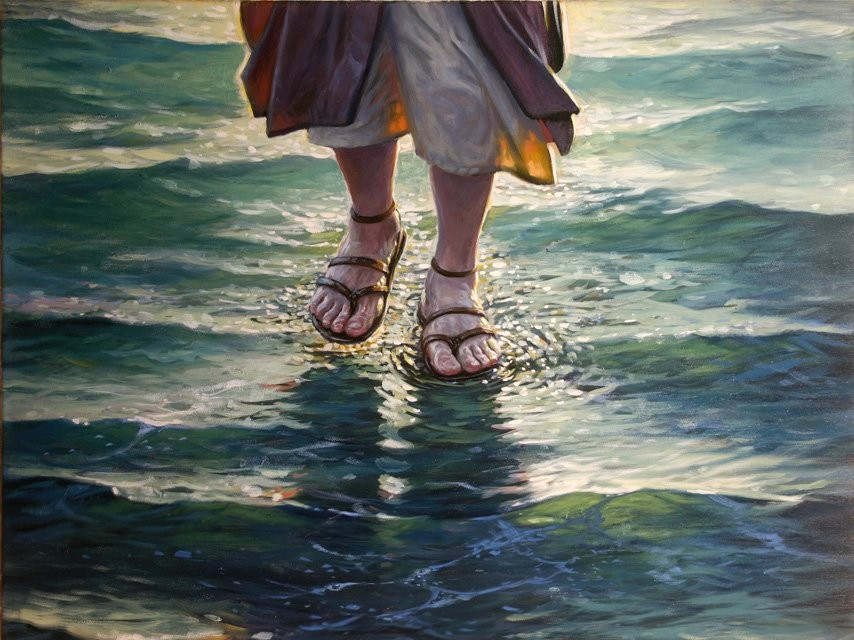
“The boat was far out to sea when the wind came up against them and they were battered by the waves. At about four o’clock in the morning, Jesus came toward them walking on the water. They were scared to death. “A ghost!” they said, crying out in terror.”

27 But Jesus was quick to comfort them. “Courage, it’s me. Don’t be afraid.”

28 Peter, suddenly bold, said, “Master, if it’s really you, call me to come to you on the water.”

29-30 He said, “Come ahead.”

Jumping out of the boat, Peter walked on the water to Jesus. But when he looked down at the waves churning beneath his feet, he lost his nerve and started to sink. He cried, “Master, save me!”

31 Jesus didn’t hesitate. He reached down and grabbed his hand. Then he said, “Faint-heart, what got into you?”

Peter is speaking:

It was the dead of night–the fourth watch, sometime between 3-6 a.m. The crossing was going all wrong, the water and wind were contrary, and we were exhausted. We had worked hard and made little headway. I seldom have seen anything like this, and the waves were pounding our boat. We had no idea how long we could keep this up.

Someone shouted and started pointing; he saw something! We all looked, and quickly came to the realization that it was Jesus–but that was impossible. It had to be His “ghost..” He was walking on water, calming striding toward us. As absurd as it seems now, we believed that. After all, what we were all seeing defied reason. No way, it was impossible!

As He got closer to our boat the apparition shouted to us.

We all knew Jesus’ voice—and He was telling us not to be afraid, He understood our fear and He wanted us to know that we were in God’s hands. Our terror got mixed up in skepticism. After all, it had been a long day and this just doesn’t happen. Besides we knew that Jesus was left back in Gaiilee.

I don’t know why to this day where my courage came, but I needed to be with Jesus. Maybe it was curiosity, maybe it was more than that. Somewhere I came up with this wild idea that if He was really Jesus then He could allow me to walk on the water. I know that seems bizarre, but my “faith” in Him was greater than anything else.

Jesus told me to join Him.

So guess what? I stepped out of the boat.

What I found was that the water was hard. It was as solid as if I were walking on land! I couldn’t figure that out, it was impossible. Completely unbelievable. I saw the waves and felt the wind–My eyes shifted from Jesus and it was then I began to sink. The water was becoming water, and I began to sink.

“Jesus, save me!”

If there was any lesson that cry moved the heart of Jesus. Perhaps that’s what has shaped my ministry today. The cry of desperation has become an integral part of my walk. At that moment I realized that is my best prayer. “Master, save me!” I use it a lot. Especially when I’m “sinking.”

Jesus grasped my outstretched hand.

I was pulled up and out of the water to safety. He gently spoke a rebuke–a kind word of instruction and direction. But I learned something.

Following Jesus is a supernatural walk.

It can’t be done in any other way. And you must get out of the safety of the boat, which must come at His invitation. He wasn’t angered by my unbelief, but I believe He was encouraged by my faith, and the lesson was clearly understood by the disciples still in the boat.

The steps of faith fall on the seeming void, but find the rock beneath.

    John Greenleaf Whittier

Little Christs

Luke 9:1-6, Amplified

Now Jesus called together the twelve [disciples] and gave them [the right to exercise] power and authority over all the demons and to heal diseases. Then He sent them out [on a brief journey] to preach the kingdom of God and to perform healing. 

And He said to them, “Take nothing for your journey [that might encumber you]—neither a walking stick, nor bag, nor bread, nor money; and do not even have two [b]tunics apiece. Whatever house you enter, stay there until you leave that city [to go to another]. And as for all those who do not welcome you, when you leave that city, shake the dust off your feet [breaking all ties with them] as a testimony against them [that they rejected My message].” 

So they began going from village to village, preaching the gospel and healing the sick everywhere.

Jesus called the twelve of us together that day for a reason–He wanted us to start doing His work, which, I admit wasn’t really in my thinking. But this was His plan, and He knew exactly what He was doing. I didn’t feel remotely competent, and the thought of doing what Jesus did seemed a bit sacrilegious. I was very intimidated.

But now I can see that was what He intended all along, to push us into the supernatural–preaching, healing, and exorcising demons. He wanted us to touch people, to meet the needs of the desperate, and by doing so, extend the kingdom of God.

We were all skeptical, obviously. We weren’t Jesus, not by a long shot, and we had no right or ability to do miracles. On our own, I we were still fishermen and tax collectors. And honestly, what Jesus was asking (or commanding?) was for us to leave what we felt was comfortable and to step into His sandals. He wanted us to be just like Him.

He gave us His authority and power–it was His to give.

I suppose that this was the key to it all. We had witnessed fantastic miracles, stunning things that pretty much undid us. Jesus repeatedly defied the laws of nature—with just a word. And we’re His disciples, so I suppose that meant we needed to step out and touch people just like He taught. I guess that was Jesus’ plan for us all along. We just thought it wouldn’t happened this quick.

So the power and authority was given and we became “little Christs.”

Two by two we went in different directions to discover for ourselves what would happen. The needs we encountered were substantial. The world was a needy place that made its home in the pain and darkness of the demonized and the desperate. It seemed overwhelming. I think we all felt weak and very inadequate.

It’s funny, but we suddenly saw all these people through His eyes–it’s like we never had seen them before. We were now cloaked in Jesus’ very own power. When we laid hands on people astonishing miracles began to happen. All at once there were needs all around us. And the people kept coming.

I began to understand what it really meant to love people. We had left the relative safety of learners and had now became doers. I suppose we realized that there was an incredible difference between the two. We were all astonished by what we saw, at that moment we had few doubts about what was happening inside of us.

It changed us like nothing else could!

Being made into “little Christs” made perfect sense. We saw fantastic miracles and dramatic victories over dark demons. The things we had seen Jesus do were now the things we were doing! Suddenly everything came together and we understood many of the words that He had tried to drill into our thick skulls.

From village to village we went–we stayed with whoever wanted us. The needs we saw were staggering, from sunrise to sunset people came. Wherever we turned there seemed to be somebody else, but Jesus’ own authority was always present, it never diminished or weakened. It was like a bubbling spring that never once ran dry.

I suppose what happened inside me was just as much a miracle as we had seen Him do for others. I was astonished–up to now I never realized how exciting it was to follow the Lord Jesus. What a joy to see the face of a man or woman who was set free. It was such a thrill to touch a little boy’s dead eyes and suddenly realize that he could see!

So this is what it honestly means to be His disciple!

“Truly I tell you, the one who believes in me will also do the works that I do. And he will do even greater works than these, because I am going to the Father.”

John 14:12

Meet the Kneeling Leper

Matthew 8:1-4, The Message

“Jesus came down the mountain with the cheers of the crowd still ringing in his ears. Then a leper appeared and dropped to his knees before Jesus, praying, “Master, if you want to, you can heal my body.”

“Jesus reached out and touched him, saying, “I want to. Be clean.” Then and there, all signs of the leprosy were gone. Jesus said, “Don’t talk about this all over town. Just quietly present your healed body to the priest, along with the appropriate expressions of thanks to God. Your cleansed and grateful life, not your words, will bear witness to what I have done.”

Look at Jesus, and listen closely to His heart. “I want to. Be clean.” He’s encountering a diseased man while listening to the crowds who are chanting His name. He’s the hero, a celebrity, the people adore Him. Who could handle the adulation? Certainly not me, I would soak up the praises and revel in my triumphal moment.

I would short-circuit.

But remember, the end of the previous verses explains exactly what’s happening. Matthew 7:28-29 explains their excitement–

When Jesus concluded his address, the crowd burst into applause. They had never heard teaching like this. It was apparent that he was living everything he was saying—quite a contrast to their religion teachers! This was the best teaching they had ever heard.

It was a wild scene, we can’t forget this. But it’s funny, Jesus through all this sees and hears this leper. He doesn’t respond to the crowd but to the diseased man. The text tells us that the leperous man was on his knees and he was “praying.” His pleas were directed at Jesus.

The crowds responded wholeheartedly to the marvelous teaching of Jesus, and that was awesome. We really shouldn’t minimize that. However, in the Gospels, the “crowd” is pretty much a bad term, or at least a neutral one.

I suppose that Jesus seems to ignore the multitude’s adulation and instead focuses on the leper. I’m not sure if I could do that. It’s nice when people flatter me. It feels so good, it feeds my ego–but the needs of others become secondary. There’s something in me that adores being in the limelight. I feel triumphant!

Jesus reacts, not to the adoration of the crowd but to the man. He sees the need of a single person.

That’s really remarkable.

Okay, so what does this really mean? Scripture tells me that Jesus stands in heaven and makes intercession for me. He focuses on just me, I’m the center of His care–but I also know that attention is also on you, and others, and yet I’m assured that He sees me and each of His sheep. This should be a comfort. He concentrates and ministers to the person.

Jesus loves you, and He loves me.

“So he told them this parable: “What man among you, who has a hundred sheep and loses one of them, does not leave the ninety-nine in the open field and go after the lost one until he finds it? When he has found it, he joyfully puts it on his shoulders, and coming home, he calls his friends and neighbors together, saying to them, ‘Rejoice with me, because I have found my lost sheep!’”

Luke 15:3-6

The Sword Meets the Ear of Malchus

Luke 22:49-51, CSB

“When those around Him saw what was going to happen, they asked, “Lord, should we strike with the sword?” 50 Then one of them struck the high priest’s servant and cut off his right ear.

51 But Jesus responded, “No more of this!” And touching his ear, he healed him.

How should we proceed with this? Perhaps we should start with the garden of Gethsemane. The setting explains a lot. Jesus is praying alone and He asks His Father for the strength to make it to His cross. It’s said that at that He sweated out what was like drops of blood.

The usual way of praying for a Jewish man was standing, but here we read that Jesus was on His knees. We also read that an angel showed up–it says that this angel came with strengthening power. The Greek word for “strengthen” can mean to invigorate. I believe Jesus’ prayer was answered (but not the way He wanted).

Jesus now had the strength to stand up and face the terror of the cross.

Judas led the mob that came to arrest Jesus. There was the kiss of betrayal and I suppose that the torchlight wasn’t really enough to identify Jesus outright. Judas’ kiss goes into the history books as the ultimate act of a traitor. It’s probably the most wicked kiss ever given to another.

What happens next seems to come out of an R–rated movie script. Peter takes up a sword and slashes and connects with a guy named Malchus who was the servant of the high priest. An ear is chopped off and Peter has a bloody sword, but not so fast. Jesus insisted that this is not the way of a true disciple.

Some would suggest that having good swordsmanship is a vital characteristic of a follower of Jesus.

But I don’t think so.

Jesus stops the whole scene to pick up Malchus’ ear and reattach it. Peter is definitely rebuked (notice the exclamation mark in verse 51)! Being a believer means following Jesus to the garden, and then the cross. Often we look at anything that avoids these places. When we’re truly following Him we are commanded to take up our own cross daily.

“When the Church takes sword in hand, it usually shows that it does not know how to wield it, and as often as not has struck the wrong man.”

Maclaren

Malchus plays such a minor role, and yet the ear amputation speaks volumes. We discover that the implications clarify the Lord’s desire for His followers–something that makes it clear that, “His ways are not our ways.”

Even in the garden, facing arrest and torture, Jesus is still reaching out to those around Him. Malchus is Jesus’ last ‘physical’ healing of another–He is kind and merciful, and He shows us how to love our enemies.

Today is Maundy Thursday. Tomorrow the pain of the cross. But He’s in the garden now, and recognizes exactly what is going down. “But this is your hour, and the power of darkness.”

“You have heard that it was said, ‘You shall love your neighbor and hate your enemy.’ 44 But I say to you, Love your enemies and pray for those who persecute you,”

Matthew 5:43-44

Jesus and the Cliff

Luke 4:28-30, CSB

” When they heard this, everyone in the synagogue was enraged. 29 They got up, drove him out of town, and brought him to the edge of the hill that their town was built on, intending to hurl him over the cliff. 30 But he passed right through the crowd and went on his way.”

When I pastored a church, I loved it when people told me that my sermon was the best they’ve ever heard. What a boost! But Jesus didn’t have that response when He preached at the synagogue in His hometown. The people went nuts! They weren’t happy with what Jesus had to say.

Nazareth was big enough (500 people) to have its own synagogue. This was the central place in the town. The village was also built very near to a sizable cliff. (You can see it today.)

It wasn’t a nicey-nice sermon, and it certainly didn’t comfort the congregation. They got really angry–Jesus point-blank confronted them. I suppose the Jewish leaders may have incited the crowd, which is sort of typical. If we take a quick peek at what He said perhaps we can understand their response (Luke 4:23-27).

But it’s really odd, initially, the people were responsive:

“They were all speaking well of him and were amazed by the gracious words that came from his mouth; yet they said, “Isn’t this Joseph’s son?”

(v. 22)

Two things immediately strike me, maybe they’re significant, and maybe not. One–This attempt to toss off the cliff came immediately after Jesus’ temptation. (One of Satan’s temptations was Jesus jumping off the pinnacle of the temple.) Two–this is Nazareth, the town where He grew up, and the people obviously had issues about this ‘familiarity.’

They couldn’t or wouldn’t accept Him.

What probably happened is this. After Jesus’ sermon, the people were enraged. They escorted Him, pushing and shoving to the cliff. Throwing Jesus off was just the beginning, as He landed they would have gathered rocks (as big as a person’s head) and they would’ve finished the deed by stoning Him. They would have aimed at His chest first, and then the head. Survival was unlikely.

Prophets and teachers are seldom respected by who is closest to them. (Trust me, I know all about this.) Joseph, Jesus’ step-dad (if he was alive) would’ve had a carpentry shop. And Mary would’ve shopped with the women of the village. Both would have been in the synagogue and part of the crowd.

So tell me. What lesson can we grasp from this passage?

We’re people who’ve got the ability to make choices. Stoning is frowned upon in our culture; but could it be that we respond to Jesus’ words in less extreme ways? Physically we can’t react like this. But could it be we ignore Him or are apathetic to the things He says to us? Might this be as “bad” as stoning? (Maybe I’m putting too fine a point on it?)

The Lord Jesus’s voice to us should never be trifled with.

The things He speaks are supremely authoritative–what He shows us is not a trivial thing. His words are always significant. What Jesus says to us mustn’t be ignored, no matter what they communicate.

As believers or nonbelievers, we must take into our hearts the word that He speaks. To minimize or nullify (by our apathy?) is incredibly dangerous. When we judge Him we’re actually judging ourselves, and that dear one is frightening. We make the decision to accept or reject Him. It’s that freedom of choice that can be scary.

What has Jesus spoken to you that you’re turning a blind eye to?

Is it possible He has spoken but you’re ignoring Him? I mean no harm and it’s not possible for me to know your heart. But maybe you’ve listened up to a certain point and ignored the things that don’t settle with you. Personally, when I read Jesus’ words in the Gospels I discover an awful lot that I don’t really want to hear. (He talks about humility and loving our neighbor before ourselves. Yikes!)

Please consider this honestly. It’s spiritually dangerous to be apathetic and not to pay attention to what you know to be the full Word of God.

“In all unbelief there are these two things: a good opinion of one’s self, and a bad opinion of God.”

    Horatius Bonar

Meet Jesus, Who Calmed a Storm

Mark 4:35-41

On that day, when evening had come, he told them, “Let’s cross over to the other side of the sea.” 36 So they left the crowd and took him along since he was in the boat. And other boats were with him. 37 A great windstorm arose, and the waves were breaking over the boat, so that the boat was already being swamped. 38 He was in the stern, sleeping on the cushion. So they woke him up and said to him, “Teacher! Don’t you care that we’re going to die?”

39 He got up, rebuked the wind, and said to the sea, “Silence! Be still!” The wind ceased, and there was a great calm. 40 Then he said to them, “Why are you afraid? Do you still have no faith?”

41 And they were terrified and asked one another, “Who then is this? Even the wind and the sea obey him!”

It was Jesus’ idea to cross the lake. It seemed He had a reason why, and as we read this we understand His motives. It’s obvious that Jesus understood that there was “people to see, and places to go,” (Mark 5:1-19). There were crowds of others who “tailed” Him, wanting to see what would happen next. Jesus was a magnet it seemed.

It seems that the boat belonged to Peter, and the journey across the water would take some time, it was 5–6 miles at this crossing point. It’s important to know that many of Jesus’ disciples were seasoned fisherman and I imagine that the trip would be fairly routine to them. But what’s going to happen next isn’t anything but.

The storm picked up quickly as they often do.

For these experienced sailors this wasn’t a big issue. Storms were manageable, however the text tells us that there came a point when the winds and waves began to fill the boat. They couldn’t bail it out fast enough. The storm seemed to ‘explode’ and it seems that they weren’t prepared to deal with this. It wasn’t in their plans.

That’s often the way things happen isn’t it? Following Jesus isn’t always smooth sailing in calm waters.

Things got so bad so quick that they turned to Jesus. Apparently He was catching 40 winks on a cushion in the back of the boat. (Why He was sleeping I have no idea; He must’ve been worn out by a full day of ministry.) When everything is spinning out-of–control it’s at the point they finally call on Him.

They woke Jesus up. (I guess if you’re about to drown it’s probably a good thing to be aware of it anyway.)

The disciples knew they had lost the battle. The storm was about to send them to the bottom of the Sea of Gaililee. In just a few moments they all were going to drown. Imminent death is a great time to call out to Him.

It was at this point that the disciples turned to Jesus. Why the delay? It doesn’t make sense, but knowing myself I only seem to call on Him when things get out-of-hand. My first response is trimming the sails and to start bailing. I don’t think about calling on Jesus until I realize that I’m not really in control.

In tradition it was God who was able to control storms, (see Psalm 107:29 and Jonah 1:4). When Jesus stood up and took on that authority over the wind and waves He was acting as the Messiah. But more than that, He was behaving as God.

Jesus’ question to them drills right to the heart of things in verse 40.

This is what triggered the response of the disciples in verse 41. Perhaps they were more scared of Jesus than the storm?

Incidently, the words Jesus used as He spoke to the storm means “be muzzled.” He uses the exact same words as He casts out the demons of the man in the very next event (Mark 5:7-9). I wonder. Could it be that the storm was a satanic/demonic attack? Maybe?

“O LORD God of hosts, who is mighty like You, O LORD? Your faithfulness surrounds You. You rule the raging of the sea; when waves rise, You still them.” 

Psalm 89:8-9

Meet the Deaf and Mute Man

“Some people brought a man who could neither hear nor speak and asked Jesus to lay a healing hand on him. He took the man off by himself, put his fingers in the man’s ears and some spit on the man’s tongue. Then Jesus looked up in prayer, groaned mightily, and commanded, “Ephphatha!—Open up!” And it happened. The man’s hearing was clear and his speech plain—just like that.”

36-37 “Jesus urged them to keep it quiet, but they talked it up all the more, beside themselves with excitement. “He’s done it all and done it well. He gives hearing to the deaf, speech to the speechless.”

Mark 7:34-37, The Message

Jesus enjoyed carrying the good news to distant places. His ministry wasn’t confined. He went to places that orthodox people avoided. Jesus penetrated these places and found a rich mission field. (This should speak volumes to us.)

It was in Decapolis that He met this man. He was deaf and mute, and it seems no doctor could help him. Close friends brought this man to Jesus. They begged Jesus to heal him–perhaps this shows their faith and love. (Again this should speak to us. Do we care for others–or not?)

The Lord led this man away from the crowd (interesting.) It seems Jesus wanted privacy. I think that He wanted to avoid the “carnival” atmosphere that healing would cause. Jesus was God–not a showman. (This dear one should clarify things for us.)

It interests me the approach He took. Jesus’ fingers went into the man’s ears. He spits (!) and touched the man’s tongue with His saliva. (Oh if He could do this to us!) Jesus looked up to heaven and said one word, “Ephphatha!” Which in English means “be opened.”

The man suddenly began to speak!

Everyone who witnessed was amazed. Jesus looked at those and told them not to say a thing about what just happened. (Is this humility or what?) Of course, it interests me that the crowd ignored His command; they couldn’t help but spread the news. They must have figured that Jesus was the Messiah, and this miracle proved it.

But the way He went about this amazes me–why the fingers and obviously why the spit? Perhaps this man, (and his friends) needed to see something more “physical.” Maybe? Could it have communicated something to Jesus’ disciples who were watching? Could it be that this can guide us as we now carry Jesus’ power?

I’m thinking through these things.

One: Jesus does impossible things He extends Himself to the “unorthodox”

Two: He seems to heal in ways we really don’t quite understand.

Three: What Jesus does is not about “showmanship,” He avoids publicity and self-promotion.

And there must be other points. It’s good I think, to roll these thoughts around.

Meet Peter and the Fishes Mouth

When they came to Capernaum, those who collected the temple tax approached Peter and said, “Doesn’t your teacher pay the temple tax?”

25 “Yes,” he said.

When he went into the house, Jesus spoke to him first, “What do you think, Simon? From whom do earthly kings collect tariffs or taxes? From their sons or from strangers?”

26 “From strangers,” he said.

“Then the sons are free,” Jesus told him. 27 “But, so we won’t offend them, go to the sea, cast in a fishhook, and take the first fish that you catch. When you open its mouth you’ll find a coin. Take it and give it to them for me and you.”

Matthew 17:24-27, CSB

Taxes! We had just arrived home in Capernaum when the tax collectors showed up. How they knew we were back in town I have no idea. But they did. I guess it shouldn’t surprise me. These guys have a tendency to show up when you’re broke.

Taxes. They knew that Jesus was a teacher, a rabbi, and they had the audacity to ask if he was somehow exempt from paying to support the Temple. I had to tell them that He to had to pay, but honestly, I wasn’t sure.

I went back into the house and Jesus was waiting to quiz me.

He surprised me by knowing what had just occurred with my encounter with these tax guys. He knew. He asked me what I thought–(Jesus always seemed to ask me questions like that. I hated being put on the spot.)

“From strangers” seemed to be the simple and logical answer. Jesus explained that He’s not liable to pay this tax, because the Father certainly doesn’t require it of His own Son. I realized then that was the real lesson that He wanted me to understand.

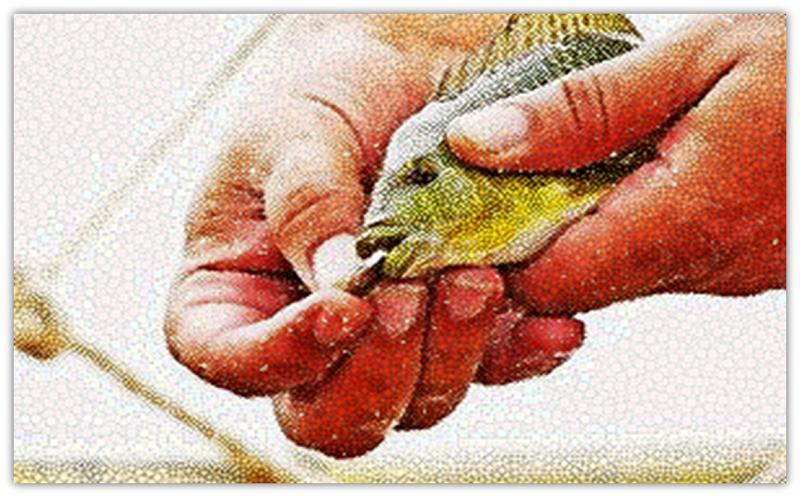
But rather than insist on His “sonship,” Jesus didn’t want to create an issue with anyone. He asked me (the commercial fisherman), to throw out a line and a hook–He told me that the first fish that I caught would have a coin in its mouth!

I must tell you that it happened exactly like He said it would.

The fish I caught had a drachma in its mouth. What can I say? It was there and it undid me. It happened and I understood again that He really did have power.

Jesus told me to pay the tax–His and mine. He knew He didn’t need to pay. Rabbis were exempt from this, and yet Jesus didn’t want to offend anyone, He paid the tax to avoid any objection.

_______________________

Bryan’s note: I’ve pondered this miracle of Jesus, and it astounds me. A fish with a coin in its mouth! But in this, He shows His power. Consider for a moment the story of Jonah where a big fish was specially created to be the vehicle for a disobedient prophet. Jesus reveals His omnipotence over all things.

Jesus is the Creator and He does this without any problem at all. He simply does it. He is God after all.

“All things were created through him, and apart from him not one thing was created that has been created.”

John 1:3, CSB

Meet Lazarus

John 11:25, 26; vv. 33-44

 25 Jesus said to her, “I am the resurrection and the life.[a] Whoever believes in me, though he die, yet shall he live, 26 and everyone who lives and believes in me shall never die. Do you believe this?” 27 She said to him, “Yes, Lord; I believe that you are the Christ, the Son of God, who is coming into the world.”

Jesus Weeps

When Jesus saw her weeping, and the Jews who had come with her also weeping, he was deeply moved[b] in his spirit and greatly troubled. 34 And he said, “Where have you laid him?” They said to him, “Lord, come and see.” 35 Jesus wept. 36 So the Jews said, “See how he loved him!” 37 

Jesus Raises Lazarus

38 Then Jesus, deeply moved again, came to the tomb. It was a cave, and a stone lay against it. 39 Jesus said, “Take away the stone.” Martha, the sister of the dead man, said to him, “Lord, by this time there will be an odor, for he has been dead four days.” 40 Jesus said to her, “Did I not tell you that if you believed you would see the glory of God?” 

 So they took away the stone. And Jesus lifted up his eyes and said, “Father, I thank you that you have heard me. 42 I knew that you always hear me, but I said this on account of the people standing around, that they may believe that you sent me.” 43 When he had said these things, he cried out with a loud voice, “Lazarus, come out.” 44 The man who had died came out, his hands and feet bound with linen strips, and his face wrapped with a cloth.

Jesus said to them, “Unbind him, and let him go.”

My name is Lazarus and I was a special “friend” of Jesus. We liked being with each other, and my sisters Mary and Martha also enjoyed fellowshipping with Him. Whenever He passed through Bethany, Jesus always had an open invitation to visit.

What’s it like to be dead? Many ask me this, and I suppose they want to understand, and I don’t blame them. To me, it seemed like a very deep sleep–but I didn’t dream. Those who look for any special insight, will not find it from me. And yet, I am His witness. He has incredible power over death.

I heard Him call my name.

It pierced through everything with an authority I’d never heard before. I had been laid in my tomb for 4 days and my physical body had begun to putrify. When they rolled the stone away the terrible smell of death lay heavy in the air.

I was tightly bound in cotton wraps and sticky spices had been applied to my body. Mary and Martha had objected to Jesus’ attempt. As I looked back I realize that their actions were justified. After all, who can give life when one is very much dead. And not only dead but well on the way on to decay. The smell wafted from my tomb.

I had heard His shout, and it was then death was reversed.

My heart and brain began to work again. When I came to I found that I was lying on a stone table and tightly wrapped in the clothes of the dead. I managed to sit up, and I shuffled toward the light that had entered the tomb by the stone that covered the door.

When Jesus saw me I believe that He was laughing. He gave the command to the shocked bystanders, He commanded them to unwrap me. I suppose that then I realized I was now in the land of the living. I can’t explain what had happened, But my grave clothes were unwrapped.

There were many that day that became believers.

Many had attested that I was most certainly dead, after all, they had attended my funeral. Some had observed that I had been slathered in the sticky ointment–fragrant spices. And a few were witnesses to see the stone rolled in place.

So many believed in Jesus’ power of resurrection that day–they were completely amazed and simply reacted to what Jesus had just done for me.

There were some who simply didn’t (or wouldn’t) believe.

There were the Pharisees and the Sadducees who wanted me dead hoping to nullify my witness and my resurrection from the dead.

Their hatred of Jesus’ ministry was only strengthened. My own resurrection proved His authority and power over even death. I was a walking and breathing miracle that they refused to accept. It got so bad that the religious leaders wanted to kill me because so many believed in my resurrection. I was a living witness to many.

Yes, I know that I’ll die again. But even now, in my second death, I’m not afraid anymore.

I had become an embarrassment to them, a constant reminder that Jesus had defeated death.

He alone can believe in immortality who feels the resurrection in him already.

Frederick W. Robertson

But some of them went away to the Pharisees and told them the things Jesus did. Then the chief priests and the Pharisees gathered a council and said, “What shall we do? For this Man works many signs. If we let Him alone like this, everyone will believe in Him, and the Romans will come and take away both our place and nation.”

John 11:53-54

Art: blogspot.com. Scripture: Christian Standard Bible, Holman Publishers; The Message, Eugene Peterson